Sports Team and Tournament Hotel Blocks: Win, Manage and Bill


Youth and amateur tournaments can fill a hotel for a weekend. They can also leave behind short pickup, damage and unpaid incidentals. Here is how to run them well.
Quick answer: Sports team and tournament blocks are won through relationships with event organizers and housing partners, then protected with firm rooming list deadlines, clear payment rules and an incidentals policy set before arrival. The revenue at risk is in short pickup, rebates owed to organizers, damage, and folios that leave without payment.
Why do sports and tournament groups matter to hotels?
Tournaments can fill rooms on weekends and in shoulder seasons when corporate demand is thin. A regional tournament may bring dozens of teams for two or three nights, often booked months ahead.
The trade-off is operational: large families, early breakfasts, late check-ins after games, and a higher chance of noise and damage. Hotels that price and contract for those realities keep the business profitable. Hotels that treat a tournament like any other group often end up with a busy weekend and weak flow-through (see GOP flow-through explained).
How do hotels win tournament room blocks?
Most tournament business comes through the event organizer, the local sports commission or visitors bureau, or a housing company that manages hotel inventory for the event. Being known to those parties, on time and easy to work with, matters as much as rate.
- Know the recurring events within driving distance and when their hotel requests go out.
- Respond to requests quickly with a clear rate, block, cut-off date and payment terms.
- Offer what teams value: breakfast timing, a gathering space, bus parking, and laundry access.
- Give coaches and team managers one point of contact before and during the stay.
- Deliver the same experience next year. Organizers remember who treated their families well.
What is a stay-to-play arrangement?
Under a stay-to-play arrangement, teams that enter a tournament are required to book rooms through the event's approved hotels, usually through a housing platform or organizer. The organizer uses the room commitment to support the event, often through a rebate or commission per room night paid by the hotel.
Terms vary widely between events. Before signing, confirm in writing:
- Who holds the contract: the organizer, the housing company, or each team.
- Who is responsible for attrition if teams do not pick up.
- The rebate or commission, what revenue it is calculated on (usually room revenue only, before tax), and when it is paid.
- Whether rooms booked outside the housing platform count toward the block and the rebate.
- How reservations are delivered to you and how changes are communicated.
How should you manage the rooming list?
Set a firm rooming list deadline, make one person on each team responsible for it, and load names well before arrival. Late and changing rooming lists are where tournaments go wrong at the front desk.
- Issue a rooming list template with names, arrival and departure dates, room type, and payment method for each room.
- Match every name to the team and the event so pickup is measured accurately.
- Release unassigned rooms on the contracted cut-off date and tell the organizer in writing.
- Reconcile the list after check-in: remove no-shows, add walk-ins who belong to the team, and flag rooms with no card on file.
- Keep a clean final list. It is the basis for attrition, rebates and any damage claims.
How do you handle damage and incidentals?
Decide before arrival who is responsible for incidentals and damage, collect an authorization or deposit that covers it, and document any damage at check-out with photos and a written note. Charges without evidence are hard to collect and easy to lose in a dispute.
- Require a card authorization for incidentals on every room, or a team-level guarantee.
- Include a clear damage and noise policy in the contract and in the welcome letter.
- Inspect rooms promptly after departure and log findings the same day.
- Post damage charges with photos, a description, and the policy the guest agreed to.
- Keep that file ready in case the charge is disputed with the card issuer (see winning more chargebacks).
How should tournament blocks be billed and paid?
Most tournament rooms are paid by individual families, while the organizer or team may pay certain charges centrally. Write the billing split into the contract, then make sure reservations are coded so charges land in the right place.
For example (illustrative numbers only)
A tournament block holds 40 rooms for 3 nights, or 120 room nights, at $139, with an 80% performance clause and a $10 per room night rebate to the organizer on picked-up rooms.
- Required pickup: 120 x 0.80 = 96 room nights.
- Actual pickup: 102 room nights, so no attrition is owed (102 is above 96).
- Room revenue: 102 x $139 = $14,178.
- Rebate owed to the organizer: 102 x $10 = $1,020.
Now assume two families checked out with unpaid incidentals of $85 and $240, and one room had $300 of documented damage. That is $625 that depends entirely on a valid card on file and good documentation. Multiply that across a season of tournaments and it becomes a real line item.
How does this connect to revenue leakage?
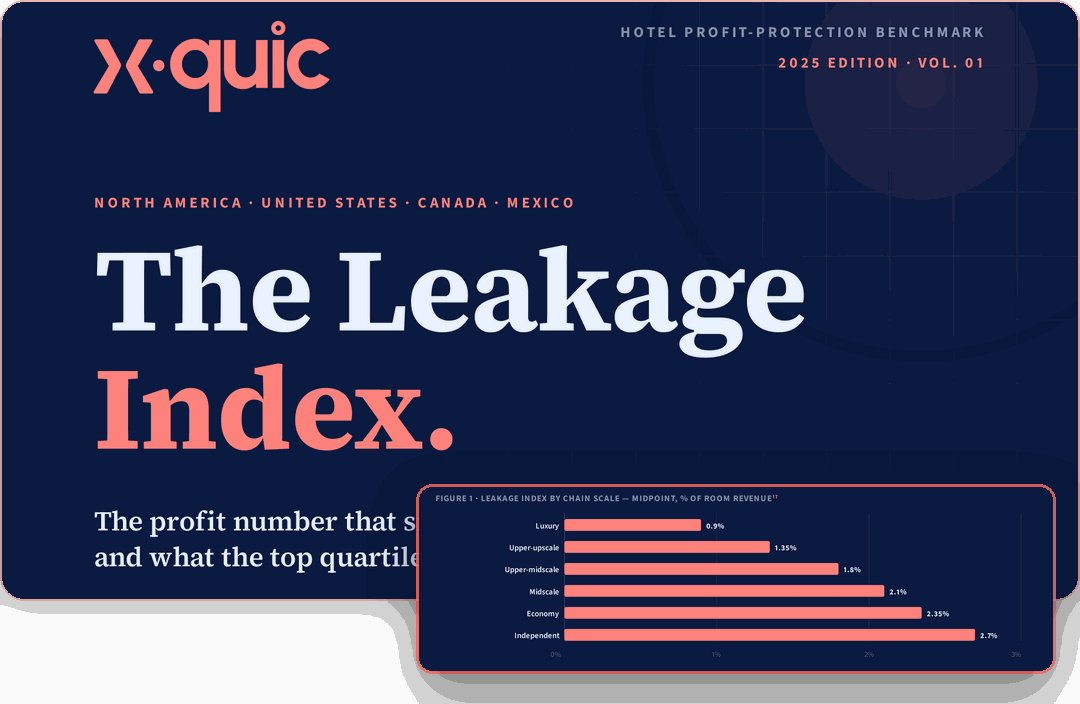
Tournament weekends concentrate the same leaks x·quic audits every day: no-show and late cancellation fees that are never charged, cards that are not authorized for incidentals, and chargebacks lost for lack of evidence. No-Show / Cancel Fee 360° monitors eligible fees 24/7, and Credit Card Chargeback 360° builds and submits evidence packets on time. A free 1-Year Profit Audit shows what your own data says. See no-show and cancellation fees and customer stories.
Frequently asked questions
Who pays attrition on a stay-to-play tournament block?
Whoever signs the contract. That may be the organizer, a housing company, or an individual team. Confirm it in writing before the event, because the families booking rooms are rarely responsible for block performance.
Are rebates to tournament organizers calculated on tax?
Usually they are calculated on room revenue before tax, but the contract governs. Pay rebates only on verified, picked-up room nights, and confirm tax treatment with your accountant.
How much should a hotel authorize for incidentals on sports groups?
There is no single standard. Set an amount that reflects your realistic exposure for damage and incidentals, apply it consistently, and state it in the contract and at booking so families are not surprised.
What if the rooming list arrives late?
Follow the contract. If the deadline passes, release unassigned rooms on schedule and accept later names on availability. Waiting indefinitely often leaves the hotel with empty rooms and no attrition claim it can support.
See your own leakage number.
Your free 1-year Profit Audit runs all six 360° audits on your own data and shows exactly what was lost and what is recoverable. No cost, no commitment, nothing to install.
Related guides


One email a month on where hotel profit leaks.
New guides, recovery data and what we are seeing across OTAs, crew lodging and payments. No spam; unsubscribe anytime.