Hotel GOP, GOPPAR and Flow-Through Explained for Owners

GOP shows how well a hotel is run, and flow-through shows how much new revenue becomes profit. Why recovered revenue beats new revenue on flow-through.
Quick answer: GOP (gross operating profit) is total hotel revenue minus departmental and undistributed operating expenses. GOPPAR is GOP divided by available room nights, and flow-through is the share of a revenue change that reaches GOP. Recovered revenue, such as uncollected fees or overbilled commissions, flows through at a much higher rate than new revenue because it carries almost no additional operating cost.
What is GOP in a hotel?
GOP is the profit a hotel earns from operations before fixed charges. In the Uniform System of Accounts for the Lodging Industry (USALI), it is total operating revenue minus departmental expenses and undistributed operating expenses.
Departmental expenses are the direct costs of rooms, food and beverage and other operated departments. Undistributed expenses include administrative and general, sales and marketing, property operations and maintenance, utilities and information technology. Items such as management fees, property taxes, insurance, rent, interest and depreciation are below GOP. The exact line placement depends on the USALI edition your hotel reports under, so confirm with your controller or management company.
Owners watch GOP because it isolates how well the hotel is run, separate from how it is financed or owned.
How do you calculate GOP margin and GOPPAR?
GOP margin is GOP divided by total revenue. GOPPAR is GOP divided by available room nights for the period.
- GOP = total revenue minus departmental expenses minus undistributed operating expenses.
- GOP margin = GOP divided by total revenue.
- GOPPAR = GOP divided by (rooms available times days in the period).
For example (illustrative numbers only): a 120-room hotel earns $4,000,000 in total revenue for the year and reports GOP of $1,400,000. GOP margin is 35% ($1,400,000 divided by $4,000,000). Available room nights are 43,800 (120 rooms times 365 days), so GOPPAR is about $31.96 ($1,400,000 divided by 43,800).
GOPPAR is useful for comparing hotels of different sizes, and it captures what RevPAR cannot: whether revenue is actually turning into profit. See hotel asset management KPIs for how it fits with other measures.
What is flow-through?
Flow-through is the change in GOP divided by the change in revenue, usually compared to budget or prior year. It tells you how much of each additional revenue dollar the hotel kept as profit.
Flow-through = (current GOP minus comparison GOP) divided by (current revenue minus comparison revenue).
If revenue rose $200,000 and GOP rose $90,000, flow-through is 45%. When revenue falls, the same formula measures how well the hotel protected profit, sometimes called retention.
Why does new revenue flow through at less than 100%?
Because most new revenue brings new costs with it. Selling one more room night means housekeeping labor, laundry, amenities, utilities, card fees and, if it came through an OTA or travel agent, commission.
Revenue from a rate increase usually flows through better than revenue from more occupancy, since a higher rate on the same room adds few new costs. Occupancy-driven growth carries the full variable cost of each additional stay.
Why does recovered revenue flow through at a much higher rate?
Recovered revenue is money the hotel already earned, already paid to service, and simply did not collect or was overcharged. The room was cleaned, the guest was served and the costs are already on the P&L. Recovering it adds almost nothing to operating expense.
Examples of recovered revenue include:
- Commissions credited back for cancelled, no-show, shortened or fraudulent OTA stays (this reduces commission expense rather than adding revenue, but the GOP effect is the same).
- Virtual cards charged in full before they expire.
- Eligible no-show and cancellation fees that were never charged.
- Chargebacks won with proper evidence.
- Crew and contract invoices paid in full rather than short-paid.
The only cost is the cost of the recovery itself. Before that, flow-through is close to 100%.
What does the difference look like in practice?
For example (illustrative numbers only): a hotel adds $100,000 of new room revenue through higher occupancy. Associated costs are $15,000 in commissions, $20,000 in housekeeping labor and supplies, $2,500 in card fees and $7,500 in other variable costs, for $45,000 total. GOP rises $55,000, a 55% flow-through.
Now the same hotel recovers $55,000 in overbilled commissions, uncharged virtual cards and missed no-show fees. None of those stays requires another room to be cleaned. Before the cost of recovery, GOP rises close to $55,000.
In this example, recovering $55,000 of leakage produces roughly the same GOP gain as selling $100,000 of new rooms. The recovery needs no additional demand, rate increase or marketing spend.
How should owners use GOP and flow-through?
Use them together. GOP and GOPPAR show how profitable the hotel is; flow-through shows whether changes in revenue are being converted into profit efficiently.
- Review GOP margin and GOPPAR monthly against budget, prior year and your competitive set.
- Ask for flow-through on every revenue variance, with an explanation when it is low.
- Separate rate-driven, occupancy-driven and recovered revenue in the discussion.
- Track leakage lines explicitly: commission expense as a share of OTA revenue, uncollected fees, write-offs and AR over 90 days.
- Compare performance across properties on GOPPAR, not only RevPAR.
For management groups, see x·quic for management companies and how to increase hotel profit without raising rates.
How does GOP connect to revenue leakage?
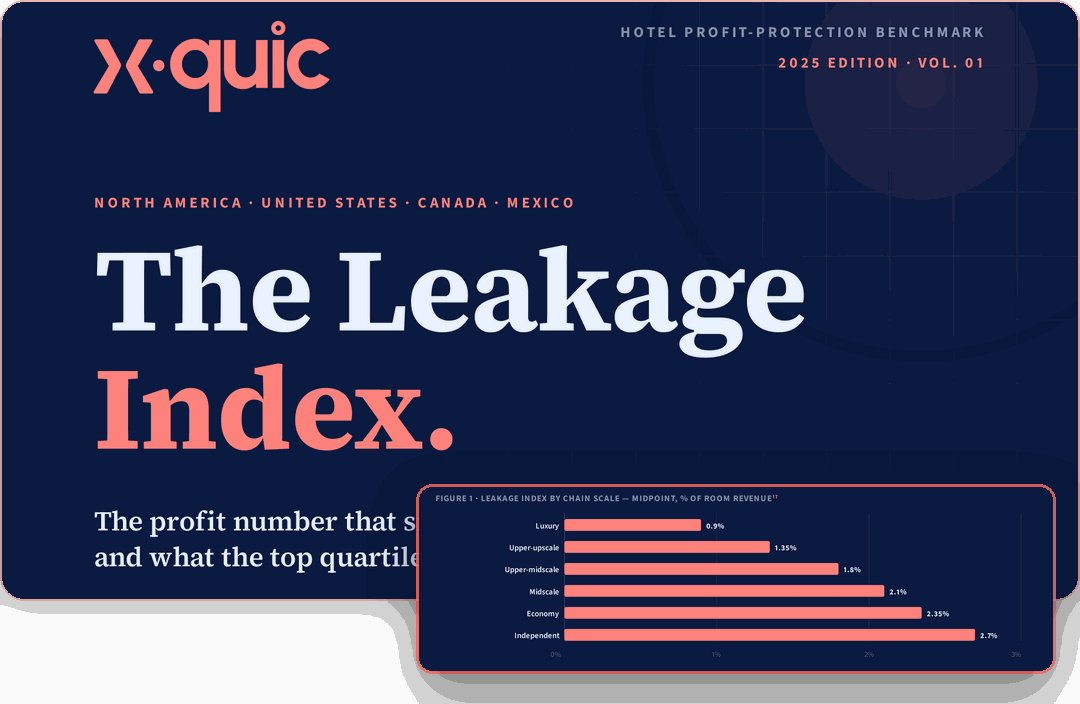
Hotels typically lose 3–12% of revenue to leakage. On a $4M hotel that is $120,000 to $480,000, and because recovered revenue carries almost no new operating cost, most of it lands in GOP. x·quic's six 360° products, from OTA Commission 360° to Credit Card Chargeback 360°, focus on exactly this high flow-through revenue. A free 1-Year Profit Audit estimates what it is worth at your property; see customer stories for published results.
Frequently asked questions
What is a good GOP margin for a hotel?
It varies widely by hotel type, market, labor costs and service level. Compare your margin to your own history, your budget and similar hotels in your market rather than to a single industry number.
Is GOPPAR better than RevPAR?
They answer different questions. RevPAR measures rooms revenue performance. GOPPAR measures how much operating profit each available room produces. Owners usually need both.
Can flow-through be higher than 100%?
Yes. If revenue rises while expenses fall, for example because commission expense dropped after credits, GOP can rise by more than revenue. Look at the components before drawing conclusions.
Are commission credits revenue or expense?
They are typically recorded as a reduction of commission expense. Either way, they increase GOP. Confirm the treatment with your accountant.
See your own leakage number.
Your free 1-year Profit Audit runs all six 360° audits on your own data and shows exactly what was lost and what is recoverable. No cost, no commitment, nothing to install.
Related guides



One email a month on where hotel profit leaks.
New guides, recovery data and what we are seeing across OTAs, crew lodging and payments. No spam; unsubscribe anytime.