Corporate Negotiated Rates and Direct Bill: A Hotel Owner's Guide


Local negotiated rates and direct bill accounts build steady midweek demand. Without controls, they also create rate leakage and slow receivables. Here is how to run both.
Quick answer: A corporate negotiated rate (often called an LNR, or local negotiated rate) gives a company a fixed or discounted rate in exchange for expected volume. A direct bill account lets that company pay by invoice instead of card. Both need a signed agreement, a credit check before any credit is extended, regular audits of who is actually getting the rate, and disciplined collections.
What is a corporate negotiated rate (LNR)?
An LNR is a rate agreed between a hotel and a specific company, usually for a year, based on the room nights the company expects to produce. It may be a flat rate, a percentage off the best available rate, or a flat rate with blackout dates.
The agreement should state the rate, room types, eligible travelers, the booking channels where the rate is loaded, any last-room availability commitment, and the volume the company expects. Without a volume figure in writing, there is nothing to measure at renewal.
How should you set up a direct bill account?
Treat a direct bill account like extending a line of credit, because that is what it is. Nothing should post to city ledger until the account has a signed application, an approved credit limit and named authorized bookers.
- Credit application: legal entity name, billing address, tax ID, accounts payable contact, and trade and bank references.
- Credit check: verify references and, for larger limits, a business credit report. Set a limit that matches expected monthly volume.
- Signed direct bill agreement: payment terms, late fees if any, what charges are billable (room and tax only, or incidentals too), and who can authorize a stay.
- Authorization per stay: a letter of authorization or purchase order for each guest, or a clear list of approved travelers.
- Account setup in the PMS: correct company profile, rate code and routing so charges land on the right account automatically.
Many hotels also ask for a card on file as a backup. Confirm with your attorney what your agreement allows you to charge to it and when.
How do you invoice direct bill accounts cleanly?
A clean invoice is one the company's accounts payable team can approve without calling you. Disputed or incomplete invoices are the main reason direct bill payments arrive late.
- Invoice promptly after check-out, or on an agreed consolidated cycle.
- Match the company's format: guest name, dates, PO or reference number, cost center if required.
- Attach a copy of the folio and the authorization.
- Separate charges the company approved from incidentals the guest should have paid.
- Send to the accounts payable address in the agreement, not only to the traveler.
For the collections side, see hotel accounts receivable and direct bill and the month-end close process.
How do you audit corporate rate compliance?
Audit rate compliance by comparing every reservation on a corporate rate code with the account it belongs to, the contracted rate, and the dates it applies. The goal is to catch guests who got the rate without being eligible, and eligible guests who were charged the wrong amount.
- Wrong rate loaded: an outdated or mistyped rate in the PMS or a distribution channel.
- Ineligible bookings: travelers from other companies using a known corporate code.
- Blackout dates ignored: the LNR honored on nights it should not apply.
- Volume shortfall: the account produces far fewer room nights than it promised, but keeps the rate at renewal.
- Leakage to other channels: the company's travelers book elsewhere, so you cannot prove volume.
For example (illustrative numbers only)
An account's contracted rate is $139. A monthly audit finds 60 room nights posted at $129 because an old rate stayed loaded in one channel. The shortfall is 60 x $10 = $600 for the month, or $7,200 over a year if nobody catches it. The same audit finds 25 room nights booked on the code by travelers from other companies, each paying $139 when your average rate on those nights was $164. That is 25 x $25 = $625 of rate given away.
How do you get paid on time?
On-time collection comes from clear terms, fast and accurate invoices, and a fixed follow-up schedule. The longer an invoice ages, the harder it becomes to collect.
- Review the city ledger aging weekly, not only at month-end.
- Contact accounts payable before an invoice is due, not after, to confirm it was received and approved.
- Escalate past-due balances on a set schedule, and suspend direct bill privileges when an account exceeds its terms or limit.
- Resolve disputes quickly by correcting the invoice rather than leaving the full balance unpaid.
- Review each account's credit limit and payment history at renewal, alongside its volume.
Direct bill also sits on the list of controls owners and asset managers review; see the financial controls checklist.
How does this connect to revenue leakage?
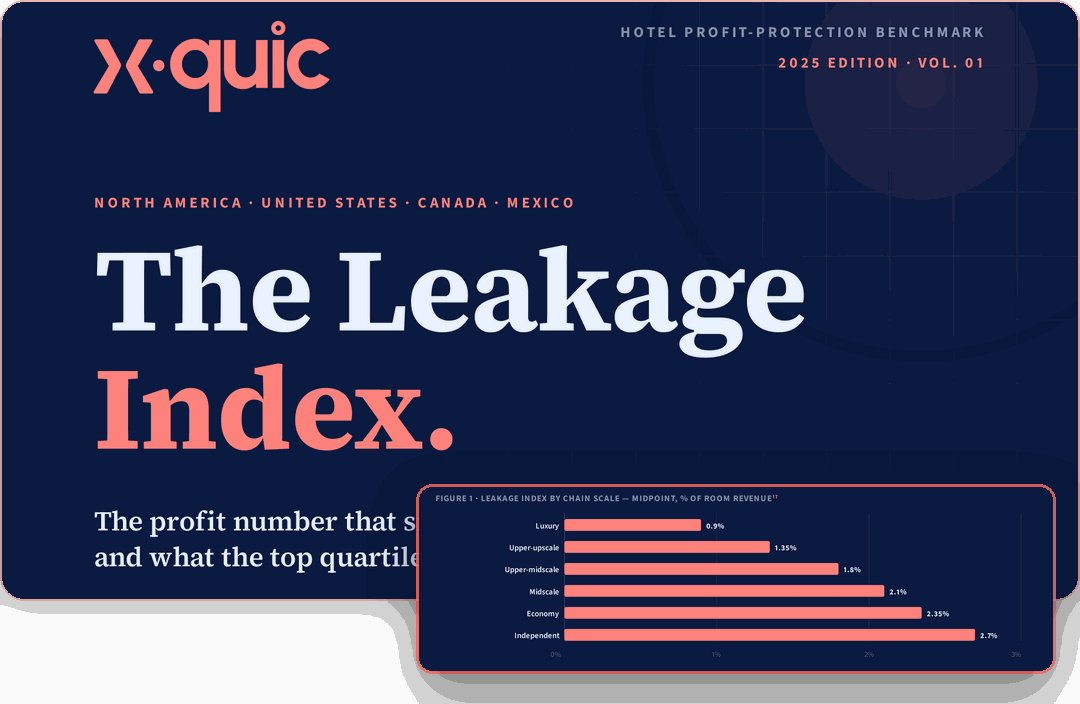
Corporate rate errors and slow direct bill collections are quieter than OTA or card problems, but they come from the same source: nobody matching what the contract says against what was actually billed and collected. Hotels typically lose 3–12% of revenue to leakage across all surfaces. A free 1-Year Profit Audit from x·quic reviews your own data, read-only, and shows where revenue is slipping. For management groups, one dashboard covers every property; see management companies.
Frequently asked questions
What does LNR stand for in hotels?
LNR usually means local negotiated rate: a rate agreed directly between a hotel and a local or regional company based on its expected room nights. Large companies may negotiate chain-wide rates through a brand instead.
Should every corporate account get direct bill?
No. Direct bill is credit. Offer it only after a credit application and check, set a limit, and require authorization per stay. Many corporate accounts pay by card and never need it.
How often should corporate rate compliance be audited?
Monthly is a practical rhythm for most hotels, with a full review of volume against commitment before each renewal. Large accounts may justify a weekly check of rate codes.
Can a hotel charge late fees on direct bill invoices?
Only if the signed agreement allows it and local law permits it. Confirm the wording and enforceability with your attorney before adding late fees to invoices.
See your own leakage number.
Your free 1-year Profit Audit runs all six 360° audits on your own data and shows exactly what was lost and what is recoverable. No cost, no commitment, nothing to install.
Related guides


One email a month on where hotel profit leaks.
New guides, recovery data and what we are seeing across OTAs, crew lodging and payments. No spam; unsubscribe anytime.