Hotel Group Contracts and Attrition: How to Calculate and Collect


Most hotels have an attrition clause. Far fewer calculate it correctly, invoice it on time, and collect it. Here is how owners and sales leaders close that gap.
Quick answer: A hotel group contract commits a group to a block of rooms at a set rate until a cut-off date. The attrition clause lets the group fall short by an agreed amount, then charges damages on the rooms it did not use. Most of the money is lost after the event, when attrition is calculated loosely, invoiced late, or waived without anyone signing off.
What is in a hotel group contract?
A group contract sets out the room block, the group rate, the dates, the cut-off date, and what happens if the group uses fewer rooms or cancels. It usually also covers food and beverage minimums, meeting space, billing arrangements and deposits.
Industry glossaries describe a room block as a set of hotel rooms, often ten or more, held at a negotiated group rate with a cut-off date. The contract is the only document that decides what the hotel can bill later, so its wording matters more than the sales conversation that produced it.
- Room block: rooms per night, by room type, for each night of the stay (the "pattern").
- Group rate and inclusions: rate, taxes, resort or facility fees, and any comps (for example, one complimentary room per a set number of paid rooms).
- Cut-off date: when unreserved rooms return to general inventory.
- Attrition clause: the allowed shortfall and how damages are calculated.
- Cancellation clause: fees if the group cancels the whole event, usually on a sliding scale by date.
- Billing: what goes to the master account, what guests pay themselves, deposit schedule and payment terms.
How does a cut-off date work?
On the cut-off date, rooms in the block that have no reservation attached go back into general inventory, and later bookings are usually accepted only on availability and often at the prevailing rate.
The cut-off date is also where many attrition disputes start. If the hotel releases rooms late, or keeps selling at the group rate after cut-off without coding those reservations to the group, pickup reports become unreliable. Decide in writing, before the event, whether post-cut-off bookings at the group rate count toward pickup.
What is attrition and how do you calculate it?
Attrition is the gap between the rooms a group committed to and the rooms it actually used, measured against the performance level the contract allows. Most clauses let the group pick up a percentage of the block (often 80% to 90%) before damages apply.
Contracts measure attrition in different ways, so read the clause before you open a calculator. Common variables include:
- Cumulative vs night-by-night: cumulative totals all room nights across the stay; night-by-night measures each night separately, which usually protects the hotel better on peak nights.
- Revised block: some contracts let the group reduce the block without penalty up to a date. Calculate against the block in force at cut-off, not the original.
- Damages basis: full group rate, or group rate multiplied by a stated profit percentage.
- Resale credit: some clauses credit the group for rooms the hotel resold, sometimes only if the hotel sold out.
- Audit of pickup: whether rooms booked outside the block (for example, through an OTA) count toward the group's pickup.
For example (illustrative numbers only)
A contract holds 200 cumulative room nights at a $169 group rate, with an 80% performance clause. The group must pick up 160 room nights (200 x 0.80). It picks up 130.
- Shortfall: 160 - 130 = 30 room nights.
- Damages at full rate: 30 x $169 = $5,070.
- If the clause applies a 75% profit factor instead: $5,070 x 0.75 = $3,802.50.
Note that the damages apply to the 30 nights below the 80% threshold, not to all 70 unused nights. Overbilling by charging against the full block is a common reason groups dispute the invoice and refuse to pay any of it.
How are cancellation clauses different from attrition?
Attrition covers a group that shows up smaller than promised. Cancellation covers a group that does not show up at all, and it is usually priced on a sliding scale that rises as the arrival date gets closer.
A typical schedule might charge a small share of anticipated room revenue if the group cancels far in advance and a much larger share inside the final weeks. Check whether the clause covers only rooms or also food and beverage and meeting space minimums, and whether the group can avoid fees by rebooking. The exact percentages and definitions are negotiated, so confirm your enforcement position with your attorney before invoicing a large cancellation.
How do you actually collect attrition?
Collection depends on speed and paperwork. Hotels that invoice attrition within days of departure, with a clean pickup report attached, collect far more often than those that send a bill two months later.
- Track pickup weekly against the contracted pattern, and send the group a written pickup report at 60, 30 and 14 days out and at cut-off.
- Audit the in-house list after departure: find guests who belong to the group but booked through other channels, and decide per the contract whether they count.
- Calculate exactly as written, showing the block, threshold, pickup, shortfall and rate on one page.
- Invoice promptly, ideally with the final master account invoice, and state the payment due date.
- Apply deposits held under the contract where the contract allows it.
- Log every waiver with the approver's name and the reason. A waiver used to win future business is a sales cost, not a billing error, but it should be visible.
- Age the receivable in your direct bill ledger and follow up on a schedule (see hotel accounts receivable and direct bill).
Where do hotels leak group revenue?
Group revenue usually leaks in the handoff between sales, reservations, front office and accounting, not in the contract itself. Each team assumes someone else is watching the numbers.
- Attrition never calculated because the event "felt full".
- Damages calculated against the original block instead of the revised block, or vice versa.
- Comp rooms applied beyond the contracted ratio.
- Group rate loaded on reservations that are not part of the group.
- Resort or facility fees waived at check-in when the contract says the group pays them.
- Food and beverage minimum shortfalls not billed.
- Cancellation fees invoiced but never followed up once the event disappeared from the calendar.
For a broader view of where these gaps sit, see where hotels lose revenue and the hotel financial controls checklist.
How does this connect to revenue leakage?
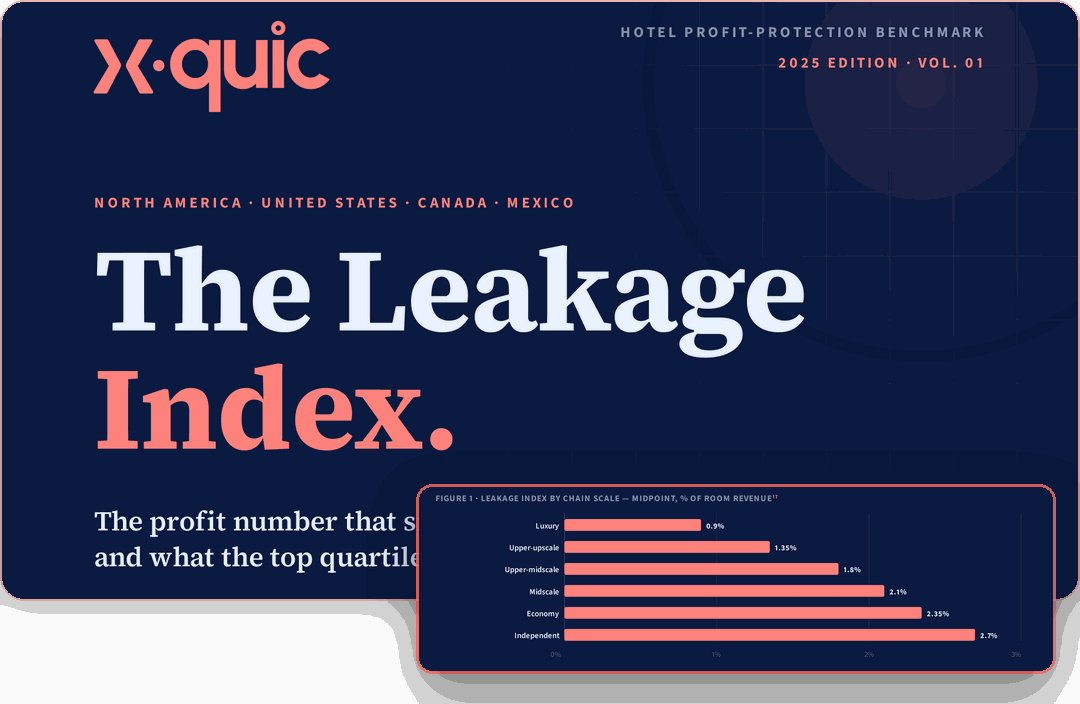
Uncollected attrition and cancellation fees are part of the same pattern x·quic sees across hotels: revenue that was earned on paper and never reached the bank. Hotels typically lose 3–12% of revenue to leakage, and group billing is one of the places it hides. A free 1-Year Profit Audit on your own data shows where the gaps are across OTA commissions, virtual cards, no-show and cancellation fees and chargebacks, so you can size the group problem alongside everything else. See pricing for how the audit works.
Frequently asked questions
Is attrition the same as a cancellation fee?
No. Attrition applies when a group arrives but uses fewer rooms than its performance threshold. A cancellation fee applies when the group cancels the event. Most group contracts contain both clauses with separate calculations.
Should attrition be calculated cumulatively or night by night?
It depends on the contract. Night-by-night measurement usually protects the hotel better when one night is the peak, while cumulative measurement is simpler and often preferred by groups. Use whatever the signed contract says.
Do rooms booked outside the block count toward pickup?
Only if the contract says so. Many groups negotiate credit for attendees who booked through other channels. If you allow it, require the group to supply an attendee list you can match against your in-house guests.
When should the attrition invoice go out?
As soon as the event checks out and pickup is final, ideally with the master account invoice. Late invoices are harder to defend and slower to collect. Confirm your collection terms with your attorney if a group disputes the charge.
See your own leakage number.
Your free 1-year Profit Audit runs all six 360° audits on your own data and shows exactly what was lost and what is recoverable. No cost, no commitment, nothing to install.
Related guides



One email a month on where hotel profit leaks.
New guides, recovery data and what we are seeing across OTAs, crew lodging and payments. No spam; unsubscribe anytime.