Group Master Account Billing and Post-Event Reconciliation


A group's final invoice is only as good as the routing set up before arrival. Here is how to build it, reconcile it, pay planner commissions correctly, and close it fast.
Quick answer: A group master account collects the charges the group itself pays, while each attendee pays their own folio. Correct billing depends on written routing instructions loaded before arrival, a daily review of the master during the event, a reconciled final invoice sent quickly after departure, and commissions to third-party planners paid only on eligible, collected revenue.
What is a group master account?
A master account is a single folio for charges the group organization has agreed to pay, such as meeting space, food and beverage, audiovisual, and rooms for staff or speakers. It is separate from the individual folios of attendees who pay their own rooms and incidentals.
The master account should mirror the contract. If the contract says the group pays room and tax for 20 staff rooms plus all banquet charges, the master should show exactly that, and nothing the group did not approve.
How do routing instructions work?
Routing instructions tell the PMS which charges from which reservations move to the master and which stay on the guest folio. Written routing, received from the group and loaded before arrival, prevents most billing disputes.
- Room and tax to master: for named staff, VIPs or all attendees, as the contract states.
- Incidentals to guest: restaurant, bar, parking and other charges stay with the attendee unless listed otherwise.
- Specific allowances: for example, breakfast up to a set amount to master, the rest to the guest.
- Authorized signers: who can sign banquet checks and add charges to the master during the event.
- Changes: a single contact who confirms routing changes in writing.
What are split folios and when should you use them?
A split folio divides one reservation's charges between two payers, typically room and tax to the master and incidentals to the guest. It is the normal setup for attendees whose room is covered but whose personal spend is not.
Every split folio needs a card on file for the guest side, collected at check-in. Without it, incidentals end up on the master by default, which the group will dispute, or get written off.
How do you prevent and resolve billing disputes?
Prevent disputes by reviewing the master account with the group contact every day of the event and having them sign off on banquet checks as charges happen. Resolve disputes by correcting the specific line, not by holding the whole invoice.
- Share a daily master account report with the group contact during the event.
- Get signatures on banquet event orders and banquet checks.
- Match each charge to the contract, the routing instructions and a signed document.
- When a line is disputed, pull its support, adjust or confirm it, and bill the undisputed balance right away.
- Record every adjustment with a reason and approver, so patterns are visible later.
Card disputes on attendee folios are a separate process; see winning more chargebacks.
How are commissions to third-party planners handled?
Third-party planners and site-selection firms are often paid a commission on the group's room revenue, as agreed in the contract. Pay it only on revenue that is commissionable under the agreement, only on actualized room nights, and usually only after the hotel has been paid.
- Confirm the rate and basis in writing: typically room revenue only, excluding tax, fees, and comp rooms.
- Calculate on actualized pickup, not the contracted block.
- Confirm whether attrition payments are commissionable. Many agreements say they are not.
- Check that the same room nights are not also being commissioned to a travel agent or a housing company.
- Pay on a set schedule and keep the calculation with the invoice.
Commission tracking for agents works the same way; see travel agent commissions.
What should the final group invoice include?
The final invoice should show every charge by category and date, deposits applied, any attrition or minimum shortfalls, and the balance due with a due date. Send it quickly, with backup the group's accounts payable team can check.
For example (illustrative numbers only)
A group routes room charges for 50 rooms for 2 nights to the master at $159, and has banquet and meeting charges. Figures are before tax.
- Room revenue to master: 50 x 2 x $159 = $15,900.
- Food and beverage: $12,400.
- Audiovisual: $1,850.
- Total charges: $15,900 + $12,400 + $1,850 = $30,150.
- Less deposit received: $30,150 - $10,000 = $20,150 balance due, plus applicable taxes.
- Planner commission at a contracted 10% of room revenue: $15,900 x 0.10 = $1,590, paid once the balance is collected.
A planner commission paid on the full contracted block of, say, 60 rooms for 2 nights would have been 120 x $159 x 0.10 = $1,908, which is $318 more than the actualized amount. Small overpayments like this repeat across every event.
How do you close the group out after the event?
Close out within days, not weeks. Reconcile the master, clear any guest balances, apply deposits, invoice, and set the account up in accounts receivable with a follow-up date (see hotel accounts receivable and direct bill).
- Confirm every routed charge landed on the master and nothing extra did.
- Clear guest folios with remaining balances before the cards expire or the guests go quiet.
- Calculate attrition and minimums exactly as the contract states (see hotel group contracts and attrition).
- Calculate and approve planner commissions against actualized revenue.
- File the contract, routing, signed checks and invoice together.
How does this connect to revenue leakage?
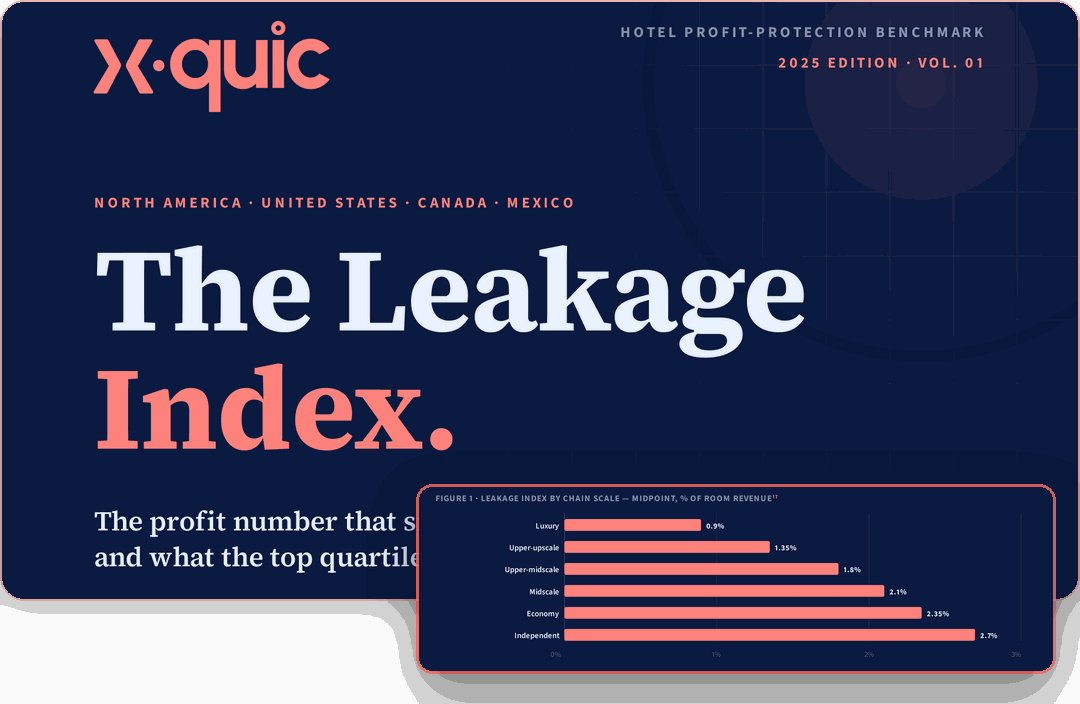
Commissions paid on the wrong basis, paid twice, or paid on revenue the hotel never collected are a classic leak. x·quic's Travel Agent 360° tracks agent commissions through to payment, and a free 1-Year Profit Audit shows where commission and billing gaps sit in your own data. Hotels typically lose 3–12% of revenue to leakage. See where hotels lose revenue.
Frequently asked questions
What is the difference between a master account and a split folio?
A master account is one folio for everything the group pays. A split folio divides a single attendee's reservation between the master (for example, room and tax) and the guest (incidentals).
Are planner commissions paid on attrition?
Only if the agreement says so, and many do not. Read the commission clause and confirm before paying.
How fast should a group final invoice go out?
As soon as the event checks out and the master is reconciled, ideally within a few business days. Late invoices are harder to collect and easier to dispute.
Who approves charges on the master account during the event?
Only the authorized signers named in the contract or routing instructions. Charges without an authorized signature are the ones most often disputed.
Track every agent commission to payment.
Your free 1-year Profit Audit reconciles travel agent commissions against the stays that actually happened. No cost, no commitment, nothing to install.
Related guides


One email a month on where hotel profit leaks.
New guides, recovery data and what we are seeing across OTAs, crew lodging and payments. No spam; unsubscribe anytime.