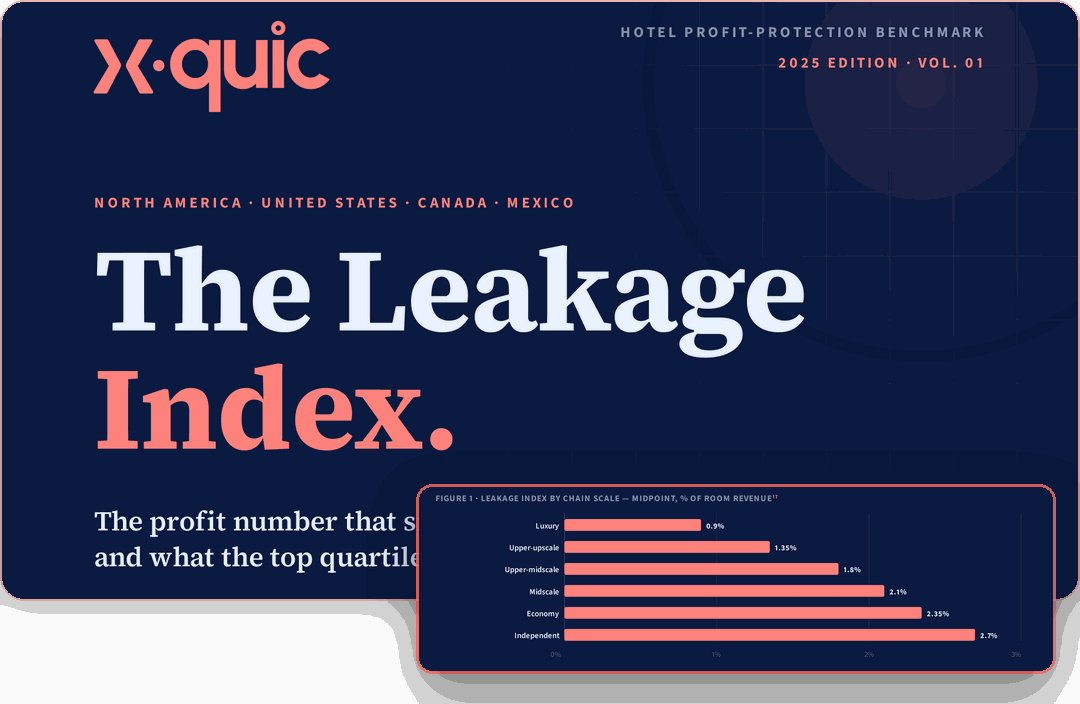
Hotel Revenue Leakage: Where Hotels Lose 3–12% and Why the PMS Misses It


Revenue you earned but never collected rarely shows up as a line item. Here are the six places it goes and how to measure your own number.
Quick answer: Hotel revenue leakage is money a hotel earned but never collected, or paid out but did not owe. Hotels typically lose 3–12% of revenue this way, depending on the property. It comes from six places: OTA commissions, OTA virtual cards, crew and contract lodging billing, no-show and cancellation fees, chargebacks, and travel agent commissions. Your PMS does not show it because each leak lives in the gap between the PMS and an outside system.
On a $4M hotel, 3–12% is $120,000 to $480,000 a year. That is often more than the property's entire marketing budget, and it rarely appears on a P&L as a line item. It shows up as slightly lower revenue, slightly higher commissions and a receivables balance nobody quite trusts.
What is hotel revenue leakage?
Hotel revenue leakage is the difference between what a hotel should have collected under its rates, contracts and policies and what it actually collected. It also includes money paid out that was not owed, like commission on a cancelled booking.
Leakage is not the same as discounting or a bad rate strategy. It is revenue you already won and then lost in billing, collection or reconciliation.
Why doesn't the PMS show revenue leakage?
The PMS records what happened at the property. It does not know what an OTA invoiced you, whether a virtual card was actually charged, what a crew contract says each night is worth, or whether a chargeback response was submitted on time. Each leak lives between two systems, and the PMS only sees one of them.
That is why hotels with excellent night audits still leak. Night audit balances the PMS to itself. Leakage audits compare the PMS to everything outside it.
Where do hotels lose revenue? The six leak sources
Almost all hotel revenue leakage falls into six categories. Most properties leak in at least three; the mix depends on your channels and guest types.
1. OTA commissions
OTAs invoice commission on reservations. If a stay was cancelled, a no-show, fraudulent or shortened, the commission may be wrong, but it is often paid anyway because nobody checks each line against the stay and the contract. Commission invoices also sometimes differ from contracted terms. Auditing each reservation shortly after check-out, while dispute windows are open, is how you catch it.
2. OTA virtual cards
On prepaid OTA bookings, the OTA pays the hotel with a virtual card that has an activation date, a set balance and an expiration window. Cards that are never charged, or charged for less than their value, are pure loss. See why OTA virtual cards go uncharged.
3. Crew and contract lodging (CLC® and similar programs)
Hotels that host rail, airline, construction or government crews bill a program instead of the guest. Unbilled nights, wrong rate tiers, tax errors, non-allowable incidentals and short-pays are common and rarely caught without line-level reconciliation. Start with our CLC lodging billing audit guide.
4. No-show and cancellation fees
If your policy entitles you to a fee and it is never charged, that is leakage. Common causes: fees waived at the desk without a reason, cards on file that decline and are not retried, and OTA no-shows that were never marked correctly.
5. Credit card chargebacks
A guest disputes a charge. If the hotel does not submit a complete evidence packet on time, it loses by default, even when it was right. Missed deadlines, not weak cases, cause many chargeback losses.
6. Travel agent commissions
Travel agent commissions need to be tracked through to payment. Without tracking, commissions can be paid on stays that did not happen, paid twice, or left unresolved and disputed later.
How do you estimate your hotel's revenue leakage?
Estimate it by sampling each leak source for one recent month, then scaling. You do not need perfect data to get a useful number.
- OTA commissions: take one month's OTA invoices and check every cancelled, no-show and shortened stay for commission charged.
- Virtual cards: list every prepaid OTA reservation from 60–90 days ago and confirm each has a matching charge for the full amount.
- Crew lodging: count crew room nights in the PMS for one month and compare to nights billed and paid.
- No-show and cancellation fees: list every no-show and late cancellation and check which eligible fees were collected.
- Chargebacks: list the last 12 months of chargebacks and note which were lost for missing or late evidence.
- Travel agent commissions: check a month of agent commissions against actual stays.
Add up what you find and multiply by 12. Then compare it to total revenue.
For example (illustrative numbers only): a $6M hotel samples one month and finds $2,400 in commission on cancelled stays, $3,100 in uncharged virtual cards, $1,500 in unbilled crew nights, $1,800 in uncollected no-show fees and $900 in chargebacks lost on timing. That is $9,700 a month, or about $116,400 a year, roughly 1.9% of revenue, from only the easy-to-find items. A full audit usually finds more, because a one-month sample misses items that surface later, like short-pays and expired cards.
What are the warning signs of revenue leakage?
You probably have meaningful leakage if any of these are true.
- No one can say how many virtual cards expired uncharged last quarter.
- OTA commission invoices are paid without line-level review.
- Crew or direct bill AR has items older than 90 days.
- No-show fees are waived without a logged reason.
- Chargebacks are handled "when someone gets to it."
- The property changed management, PMS or key accounting staff in the last year.
What should you do about revenue leakage?
Measure it, recover what is still recoverable, then fix the process so it stops. In that order, because recovery windows close.
- Measure: run the six-source estimate above, or get a full audit on your data.
- Recover: charge open virtual cards, dispute wrong commissions, rebill crew nights, and chase short-pays before time limits pass.
- Fix the cause: rate codes, folio routing, card-charging steps, policy enforcement and chargeback deadlines.
- Monitor monthly: one owner, one report, every category.
Management companies should run this the same way across every property. See revenue recovery for hotel management companies.
What do real results look like?
Hotel Nikko San Francisco reclaimed $115,876 and 300+ hours (read the story). The Watergate Hotel recovered over $100,000, including commissions on fraudulent bookings (read the story). Hotel Californian recovered $73,412 in 11 months, and Hyatt Place Nashville Airport recovered $19,755 across two leak surfaces. See all customer stories.
How x·quic helps
x·quic covers all six leak sources with OTA Commission 360°, Virtual Card 360°, CLC® Secure 360°, No-Show / Cancel Fee 360°, Credit Card Chargeback 360° and Travel Agent 360°. The free 1-Year Profit Audit measures your own number on your own data, with read-only access, no cost and nothing to install. See the FAQ and pricing.
See your own leakage number.
Your free 1-year Profit Audit runs all six 360° audits on your own data and shows exactly what was lost and what is recoverable. No cost, no commitment, nothing to install.
Related guides


One email a month on where hotel profit leaks.
New guides, recovery data and what we are seeing across OTAs, crew lodging and payments. No spam; unsubscribe anytime.