Hotel Accounts Receivable and Direct Bill: Best Practices

Direct bill is valuable business and real risk. How controllers approve credit, invoice cleanly, work the aging and collect from crew, corporate and group accounts.
Quick answer: Strong hotel accounts receivable starts before the guest arrives: approve credit, set billing terms in writing, and capture exactly what the account will pay for. After checkout, invoice fast and accurately, age the city ledger weekly, work every past-due account with a named owner, and write off only under a documented policy.
What is hotel direct bill and the city ledger?
Direct bill lets an approved company, group or agency settle charges on invoice after the stay instead of at checkout. Once the guest checks out, the folio balance moves from the guest ledger to the city ledger, which is the hotel's accounts receivable.
Direct bill is valuable business. Corporate accounts, crew contracts, groups, government and workforce lodging all depend on it. It also carries risk: every dollar in the city ledger is revenue the hotel has earned but not yet collected. See our glossary for related terms.
How should hotels approve direct bill credit?
Approve credit before the first stay, in writing, with a limit and terms. No account should be set up at the front desk on the day of arrival.
- Signed direct bill application with legal entity name, billing address and AP contact.
- Trade or bank references, or a credit check, sized to the expected volume.
- A credit limit and payment terms (for example, net 30).
- Authorized charges defined: room and tax only, or incidentals, meals, parking.
- Required billing details: PO numbers, employee IDs, cost centers, rooming lists.
- Approval signed by the controller or GM, not the salesperson who booked the business.
Review limits at least annually and whenever an account's volume or payment behavior changes.
What makes a hotel invoice get paid on time?
An invoice gets paid when it is fast, correct and matches what the payer's AP team expects. Most late payments trace back to missing references or charges the account did not authorize.
Send invoices within a day or two of checkout. Include the folio detail, stay dates, guest names, rate, taxes and every reference the account requires. If the contract says room and tax only, route incidentals to the guest at checkout rather than onto the invoice. One disputed line can hold up payment of the whole invoice.
For accounts that pay through a third-party program or portal, bill in the format the program requires and keep proof of submission.
How should the AR aging be managed?
Age the city ledger in standard buckets (current, 31–60, 61–90, 90+ days) and review it weekly, not only at month-end. The older a receivable gets, the less likely it is to be collected.
For example (illustrative numbers only): a hotel carries $186,000 in AR. $112,000 is current, $41,000 is 31–60 days, $19,500 is 61–90 days and $13,500 is over 90 days. That means about 17.7% ($33,000) is more than 60 days old and about 7.3% is over 90. If the hotel bills about $140,000 of direct bill charges a month, days sales outstanding is roughly 40 days ($186,000 divided by $140,000, times 30). Track those two numbers monthly; the trend matters more than any single month.
Also watch unapplied cash and credit balances. A payment that cannot be matched to an invoice makes the aging look worse than it is and hides real past-due balances.
What does an effective collections process look like?
An effective process is scheduled, documented and escalates on a fixed timeline. Everyone knows who calls whom and when.
- Day 0–2: Invoice sent with full backup.
- Before due date: Confirm large invoices were received and entered by the payer's AP.
- 1–15 days past due: Friendly reminder with a copy of the invoice.
- 16–30 days past due: Phone call to AP, then to the account contact. Log every contact.
- 31–60 days past due: Escalate to the GM or sales leader who owns the relationship. Consider suspending direct bill privileges for new stays.
- 60+ days past due: Formal demand, payment plan, or referral according to your policy. Review with ownership before involving outside collections or counsel.
How should hotels handle billing disputes?
Treat every dispute as a documentation problem first. Pull the folio, the signed registration card, the rooming list, the contract terms and any correspondence, then respond in writing.
Separate the disputed amount from the undisputed amount and ask for the undisputed portion to be paid now. Record the root cause of every dispute (wrong rate, unauthorized charge, missing reference, duplicate billing). Patterns in root causes tell you what to fix at the front desk.
How are crew, corporate and group billing different?
Each type pays differently, so each needs its own billing checks.
- Crew and workforce lodging: Rooms are often billed through a lodging program or contract with specific rules for occupancy, early departures and cancellations. For example, many railroad crew stays are billed through CLC® (now Corpay Lodging). Audit what was billed against how the contract pays. See CLC lodging invoice reconciliation and the crew lodging billing errors checklist.
- Corporate accounts: Negotiated rates, PO or cost center requirements, and limits on incidentals. Most disputes come from charges outside the agreement.
- Groups: Master account versus individual pay, attrition and cancellation clauses, deposits and final reconciliation against the signed contract. Bill attrition when the contract supports it.
What should a hotel write-off policy include?
A write-off policy should state when a balance may be written off, who can approve it, and what collection steps must be completed first. It protects the hotel from both lost revenue and quiet adjustments.
- Minimum age and completed collection steps before write-off.
- Approval levels by dollar amount (for example, controller, then GM, then ownership).
- Documentation required in the file.
- Monthly report of all write-offs and adjustments to ownership.
- Rules for small-balance write-offs, so they cannot be used to hide larger problems.
Confirm the accounting and tax treatment of bad debt with your accountant.
How does AR connect to revenue leakage?
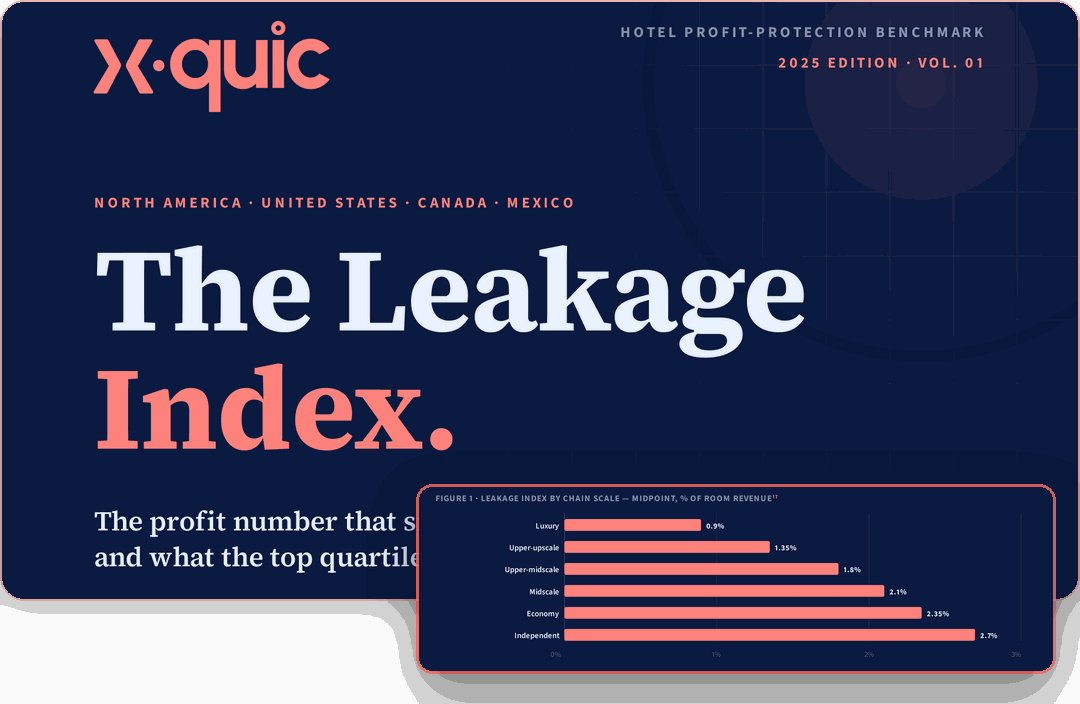
Receivables are where earned revenue quietly becomes lost revenue: short-paid crew invoices, unbilled attrition, expired virtual cards and aging balances nobody owns. x·quic's CLC® Secure 360° audits crew and government lodging line by line against the contract, and Virtual Card 360° makes sure OTA virtual cards are charged in full before they expire. The free 1-Year Profit Audit runs on your own data with read-only access. Read crew lodging profitability for related context.
Frequently asked questions
What is a healthy percentage of AR over 90 days?
There is no single standard; it depends on your account mix and contract terms. What matters is a stable or falling trend and a documented plan for every balance over 90 days.
Should the front desk be able to set up direct bill accounts?
No. Credit approval should sit with accounting or the GM. The front desk should only post to accounts that are already approved and on file.
How often should the city ledger be reviewed?
Weekly for aging and collections, and monthly as part of the month-end close, when the aging is tied to the general ledger.
Is a short-paid crew invoice worth disputing?
Usually yes. Small short-pays repeat across many stays, and the total over a year can be significant. Document the contract term that supports the charge and submit it within the program's dispute window.
See your own leakage number.
Your free 1-year Profit Audit runs all six 360° audits on your own data and shows exactly what was lost and what is recoverable. No cost, no commitment, nothing to install.
Related guides

One email a month on where hotel profit leaks.
New guides, recovery data and what we are seeing across OTAs, crew lodging and payments. No spam; unsubscribe anytime.