What the Night Audit Misses: The Gap Between PMS and Payment


A balanced night audit proves the PMS agrees with itself. It does not prove the hotel was paid correctly. Here is what falls through, and how to close the gap.
Quick answer: The night audit proves that the day balances inside the PMS: postings, room status, payments and folios all agree with each other. It does not check the PMS against the outside parties that actually pay the hotel, such as OTAs, card processors, banks and contract billing programs. That gap is where most revenue leakage lives.
What does the night audit actually do?
The night audit closes the business day inside the property management system. It posts room and tax, verifies that postings balance, and produces the reports that start the next day.
A typical audit includes:
- Posting room and tax to every in-house folio.
- Reconciling room status between housekeeping and the front desk.
- Balancing department postings (rooms, F&B, parking, other) to the daily revenue report.
- Balancing cash and card payments taken by each shift.
- Running no-show and cancellation lists.
- Reviewing rate discrepancies, overrides and high-balance folios.
- Rolling the date and backing up the system.
This is essential work. It catches posting errors, missed charges, room status mismatches and cashiering problems while they are still fresh.
Why can't the night audit catch everything?
Because it is a closed loop. Every check compares one PMS record to another PMS record. If the PMS is internally consistent but disagrees with what an OTA invoices, what a processor settles, or what a contract pays, the audit still balances.
The night auditor also works on a one-day window. Many leaks only appear weeks later: when the OTA invoice arrives, when a virtual card expires, when a crew invoice is short-paid, or when a chargeback lands. By then, the day was "balanced" long ago.
What does the night audit miss with OTAs?
It misses commission billed on revenue the hotel never earned. The PMS shows what happened; the OTA invoice is built from the OTA's own record, which often was not updated.
For example (illustrative numbers only): a guest books three nights at $180 through an OTA with an 18% commission, then checks out after one night. The PMS is corrected and the night audit balances. The OTA still bills commission on three nights: $540 times 18% equals $97.20. The correct commission on one night is $180 times 18%, or $32.40. The hotel is overbilled $64.80 on one reservation. Repeated across a year of shortened stays, cancellations, no-shows and fraudulent bookings, the total adds up. See OTA commission overbilling and OTA fraudulent bookings.
What does the night audit miss with virtual cards?
It misses virtual cards that were never charged, or only partly charged. The folio can show the reservation as prepaid by the OTA and balance perfectly, while the card itself sits untouched until it expires.
Virtual cards often have activation dates and expiration dates, and the authorized amount may not match the final folio after changes. None of that is visible in a standard audit report. Read OTA virtual card not charged for how this happens.
What does the night audit miss with card processing and banks?
It misses anything that happens after the batch closes. The audit confirms the batch was sent. It does not confirm that the full amount was deposited, that fees were correct, or that a chargeback did not later reverse it.
- Batches that failed or settled short.
- Chargebacks and retrievals that arrive weeks later.
- Refunds issued to a different card than the original charge.
- No-show and cancellation fees that were eligible but never charged, or charged and then disputed.
These only surface when you reconcile processor reports and bank deposits, which is a month-end close task, not a night audit task.
What does the night audit miss with contracts and direct bill?
It misses the difference between what the hotel posted and what the contract actually pays. The audit confirms that a crew room was posted at the contracted rate. It does not confirm that the billing program will pay for that night, or that the invoice was paid in full.
Crew and government lodging contracts often have specific rules for early departures, extensions, cancellations and room types. When a program pays less than the contract supports, the difference sits in AR or gets written off without anyone connecting it to the stay. See CLC lodging billing errors for common examples.
How do hotels close the gap the night audit leaves?
Add a second layer of reconciliation that compares the PMS to each outside party, reservation by reservation, after checkout.
- Match every OTA invoice line to the actual stay and contracted commission.
- Check every virtual card reservation for full charge before expiration.
- Reconcile card settlements to processor reports and bank deposits by day.
- Monitor eligible no-show and cancellation fees daily.
- Audit contract and crew invoices against the contract terms and track short-pays.
- Match travel agent commissions to completed stays.
The night audit and this second layer do different jobs. Neither replaces the other.
How does this connect to revenue leakage?
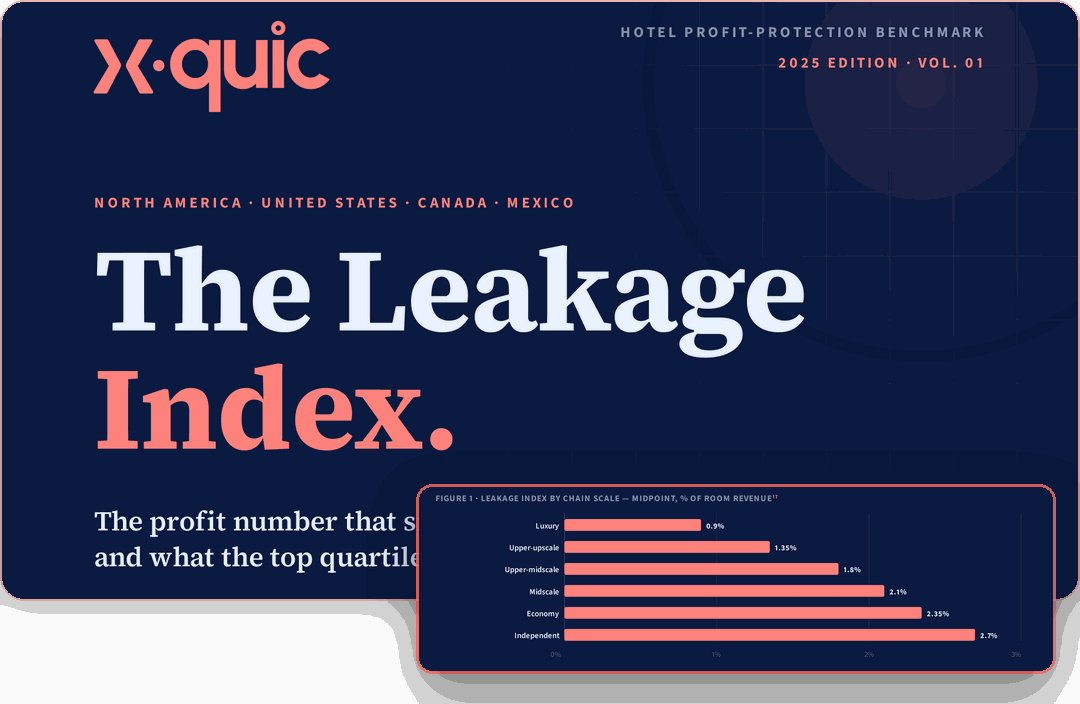
The night audit tells you the day balanced. It cannot tell you whether the hotel was paid correctly. Hotels typically lose 3–12% of revenue in that gap, which is why x·quic's OTA Commission 360° audits every reservation 72 hours after checkout and Virtual Card 360° reconciles every virtual card before it expires. A free 1-Year Profit Audit, run on your own data with read-only access, shows what your audits have been passing. For the full map, read where hotels lose revenue.
Frequently asked questions
Is the night audit an accounting audit?
No. It is an operational close of the business day inside the PMS. It is not an independent financial audit, and it does not verify balances against outside parties.
Should the night auditor reconcile OTA invoices?
Usually not. OTA invoices arrive on the OTA's billing cycle, well after the audit date. That work belongs to accounting or a dedicated reconciliation process.
If our night audit always balances, are we losing revenue?
Possibly. A balanced audit only shows the PMS agrees with itself. Commission overbilling, uncharged virtual cards and contract short-pays can all exist alongside a perfectly balanced audit.
What report helps most after the audit?
A post-checkout reservation report that shows, for each stay, what the hotel billed, what each outside party billed or paid, and the difference.
See your own leakage number.
Your free 1-year Profit Audit runs all six 360° audits on your own data and shows exactly what was lost and what is recoverable. No cost, no commitment, nothing to install.
Related guides


One email a month on where hotel profit leaks.
New guides, recovery data and what we are seeing across OTAs, crew lodging and payments. No spam; unsubscribe anytime.