Hotel Asset Management KPIs: Definitions and How to Use Them


Definitions, formulas and worked examples for the KPIs asset managers use to judge hotel performance, from RevPAR and GOPPAR to flow-through, NOI and leakage rate.
Quick answer: Hotel asset managers should track a core set of KPIs: occupancy, ADR and RevPAR for top-line performance; GOP, GOPPAR, flow-through and NOI for profitability; and labor cost, distribution cost and leakage rate for efficiency. Each one answers a different question, so read them together and against budget, prior year and the competitive set.
Which KPIs matter most for hotel asset management?
The KPIs that matter most are the ones that connect revenue to profit to owner cash flow. A hotel can lead its market on RevPAR and still underperform on NOI if costs or leakage are out of line.
- Top line: occupancy, ADR, RevPAR, RevPAR index.
- Profitability: GOP, GOP margin, GOPPAR, flow-through, NOI.
- Efficiency: labor cost, distribution cost, leakage rate.
The best asset managers review a small, stable set every month rather than a long dashboard that changes each quarter. Stability makes trends visible and keeps the conversation with the operator focused on causes, not on reconciling different versions of the numbers.
Consistent definitions matter. Most US hotels report using USALI (the Uniform System of Accounts for the Lodging Industry), which makes it possible to compare departments and hotels on the same basis. The definitions below follow common industry usage; confirm how your own reports calculate them.
How are occupancy, ADR and RevPAR calculated?
Occupancy is rooms sold divided by rooms available. ADR (average daily rate) is room revenue divided by rooms sold. RevPAR (revenue per available room) is room revenue divided by rooms available, which also equals ADR multiplied by occupancy.
For example (illustrative numbers only): a 150-room hotel over a 30-day month has 4,500 available room nights. It sells 3,375 and earns $472,500 in room revenue.
- Occupancy: 3,375 ÷ 4,500 = 75%.
- ADR: $472,500 ÷ 3,375 = $140.
- RevPAR: $472,500 ÷ 4,500 = $105 (or $140 × 75%).
How to use them: compare RevPAR with your competitive set (the RevPAR index) to see whether you are gaining or losing share. A rising ADR with falling occupancy may be a pricing decision or a warning sign; the index tells you which.
What are GOP, GOP margin and GOPPAR?
GOP (gross operating profit) is total revenue minus departmental and undistributed operating expenses, before management fees, fixed charges and reserves. GOP margin is GOP divided by total revenue. GOPPAR is GOP divided by available rooms.
Continuing the example: the hotel earns $560,000 in total revenue and $210,000 in GOP.
- GOP margin: $210,000 ÷ $560,000 = 37.5%.
- GOPPAR: $210,000 ÷ 4,500 = about $46.67.
How to use them: GOPPAR is often a better measure of operator performance than RevPAR because it reflects both revenue and cost control. Compare it with prior year and budget each month.
What is flow-through and why do asset managers watch it?
Flow-through is the change in GOP divided by the change in total revenue. It shows how much of each additional revenue dollar reaches profit, or how well costs were cut when revenue fell.
For example (illustrative numbers only): if total revenue is $40,000 higher than last year and GOP is $18,000 higher, flow-through is $18,000 ÷ $40,000 = 45%.
How to use it: set a target flow-through in the budget and ask for an explanation when actual results miss it. See hotel GOP and flow-through explained for more detail.
How is NOI different from GOP?
NOI (net operating income) is what remains after GOP less management fees, fixed charges such as property taxes and insurance, and usually a reserve for replacement. NOI is the number that drives valuation and debt service coverage, so it is the owner's bottom line.
Because management fees and fixed charges sit between the two, GOP tells you how well the hotel is operated, while NOI tells you what the investment actually returns.
How to use it: track NOI against the underwriting from acquisition, and watch fixed charges separately so a tax or insurance increase is not mistaken for an operating problem.
How should you track labor cost and distribution cost?
Labor cost is total wages, salaries and benefits divided by total revenue, often also tracked as hours per occupied room. Distribution cost is the total of OTA commissions, travel agent commissions, GDS and channel fees, and similar acquisition costs, usually measured against room revenue.
For example (illustrative numbers only): in the same month, labor of $190,400 is 34% of $560,000 in total revenue. Distribution costs of $56,700 are 12% of $472,500 in room revenue.
How to use them: labor is the largest controllable cost, so review it weekly against occupancy. For distribution, check both the channel mix and whether you are being billed correctly. Read the true cost of OTA bookings and OTA commission overbilling.
What is leakage rate and how do you measure it?
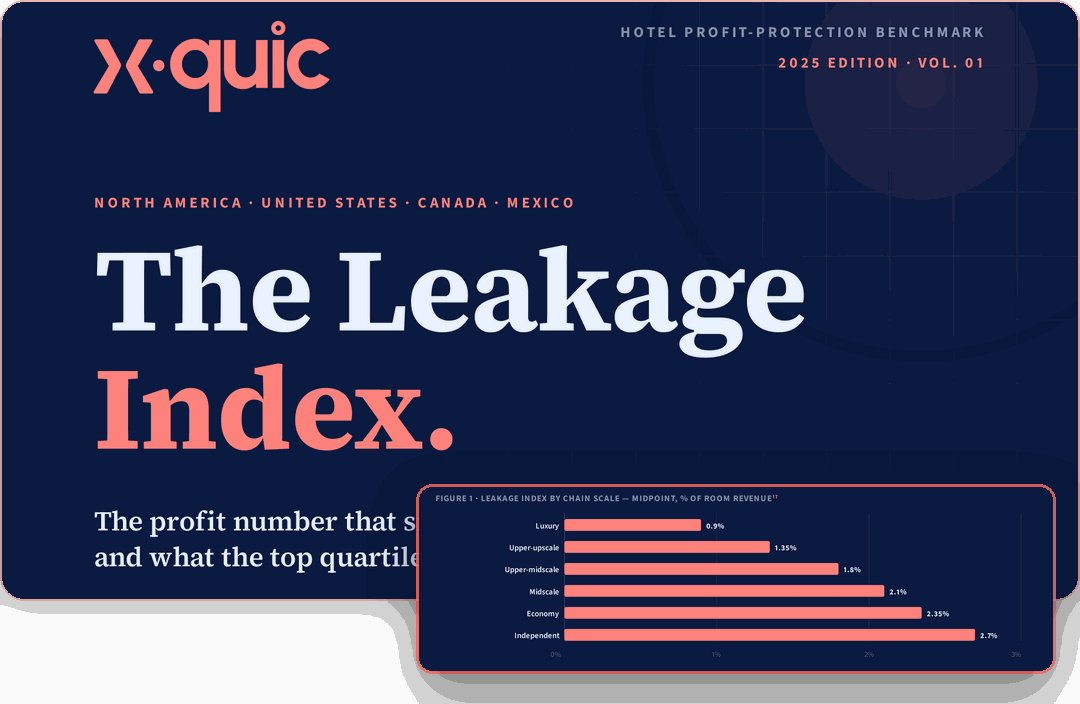
Leakage rate is revenue earned but not collected, plus costs paid but not owed, divided by total revenue. It captures what the other KPIs miss: uncharged virtual cards, overbilled commissions, lost chargebacks, unposted no-show fees and unpaid direct bill invoices.
For example (illustrative numbers only): if an audit finds $11,200 of leakage in a month with $560,000 of total revenue, the leakage rate is 2%.
How to use it: hotels typically lose 3–12% of revenue to leakage, so even a small rate is material to NOI. Track it monthly by category, and ask your operator who owns each one. See where hotels lose revenue.
How does x·quic help asset managers track leakage?
x·quic gives asset managers and ownership a role-based view of recovered revenue across one property or a full portfolio, alongside the GM and controller views. A free 1-Year Profit Audit on the hotel's own data shows your starting leakage rate with read-only access and nothing to install. Learn more on our management companies page.
Frequently asked questions
What is the most important KPI for hotel owners?
For owners, NOI matters most because it drives value and debt coverage. GOPPAR and flow-through are the best measures of how well the operator produces it.
Is RevPAR enough to judge a hotel's performance?
No. RevPAR shows top-line performance only. Pair it with GOPPAR, flow-through and leakage rate to see whether revenue becomes profit.
How often should asset managers review KPIs?
Monthly for the full set, with weekly checks on occupancy, ADR, labor and AR.
Where can I find KPI definitions?
USALI sets standard reporting definitions. Our glossary also defines common hotel finance terms.
Know what every hotel in the portfolio is leaking.
Run the free 1-year Profit Audit across your properties, including any hotel you are taking over, and see leakage by hotel, brand, and product in your own numbers. No cost, no commitment.
Related guides



One email a month on where hotel profit leaks.
New guides, recovery data and what we are seeing across OTAs, crew lodging and payments. No spam; unsubscribe anytime.