How to Increase Hotel Profit Without Raising Rates


Rate increases are the loudest lever and the riskiest. For most hotels, the fastest profit sits in revenue already earned but never collected, and in costs nobody is checking.
Quick answer: The fastest way to increase hotel profit without raising rates is to collect every dollar you already earned, then lower the cost of each booking. That means auditing OTA commission invoices, charging every virtual card, enforcing no-show and cancellation fees, winning chargebacks, clearing receivables and tightening labor and energy. Because this money is already earned, most of it flows straight to the bottom line.
Why raising rates is not always the best profit lever
A rate increase only helps if demand holds, and in many markets it does not. Push ADR too far and occupancy, channel ranking and group pickup can all slip.
Recovered revenue works differently. A commission refund, a charged virtual card or a won chargeback carries almost no added cost to produce. It does not require a guest to accept a higher price. It simply closes the gap between what the hotel earned and what it banked.
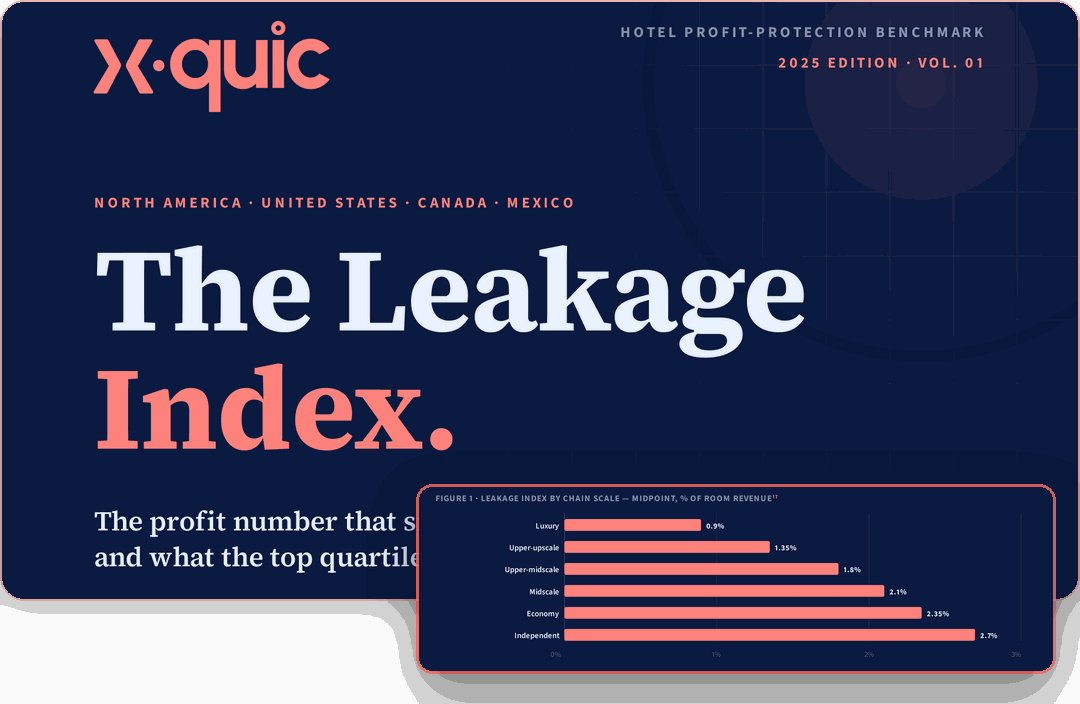
Across properties, that gap is usually 3–12% of revenue, depending on the hotel. On a $4M hotel, that is $120,000 to $480,000 a year.
For example (illustrative numbers only): a hotel with $4,000,000 in annual revenue recovers 1% of revenue through commission disputes, charged virtual cards and enforced fees. That is $40,000. Because that money was already earned, nearly all of it reaches profit. To produce the same $40,000 of profit from new room revenue at a 30% flow-through, the hotel would need about $133,333 in additional revenue. For more on flow-through, see hotel GOP flow-through explained.
How do you collect the revenue you already earned?
Start by reconciling what was booked, what was stayed and what was paid. Most leakage lives in the handoffs between those three records.
- Virtual cards: OTA virtual cards expire. A card that is never charged, or charged for less than the stay, is lost revenue. Charge the full authorized amount after activation and before expiry.
- Direct bill and contract accounts: Corporate, crew and government accounts often pay late, short or on the wrong rate. Aged items rarely collect themselves.
- Travel agent and third-party payments: Confirm that what the agent or intermediary owes actually arrives.
A monthly reconciliation of these items, owned by one named person, prevents most of it from slipping.
How can you lower distribution costs without losing bookings?
You lower distribution cost by paying only the commission you actually owe, then shifting the right guests to cheaper channels over time.
OTA invoices frequently include commission on stays that were cancelled, ended early, never showed or were fraudulent. Those charges are disputable, but only if someone checks each reservation against what actually happened. Our guide to OTA commission overbilling covers the patterns, and the true cost of an OTA booking shows why the headline commission rate understates the real expense.
Once billing is clean, work the channel mix: capture guest emails at check-in, make repeat stays easy to book direct and review which OTA promotions are actually producing incremental business.
Are you enforcing the fees your policies already allow?
Many hotels have sound no-show, late cancellation and damage policies but inconsistent enforcement. Fees get waived at the desk, forgotten on busy nights or charged to a card that has already been released.
Consistent enforcement starts with clear written policies, a daily review of eligible reservations and a record of every waiver with a reason. The no-show and cancellation fee guide explains how to set this up.
Also make sure mandatory fees are disclosed correctly. Under the FTC Rule on Unfair or Deceptive Fees, effective May 12, 2025, businesses that advertise short-term lodging prices must show the total price, including mandatory fees, upfront. Confirm your website and channel setup with your brand and counsel.
How much profit is hiding in chargebacks?
Chargebacks are often treated as a cost of doing business, but many are winnable with the right documentation submitted on time.
The problem is usually process, not merit. Evidence such as the registration card, signature, ID match, folio and communication records is scattered, and response windows are short. Hotels that build a standard evidence packet and respond to every dispute win more of them. See how to win more chargebacks.
Where else can owners cut cost without hurting the guest?
After revenue collection, labor and energy are the two cost lines most owners can move without touching the guest experience.
- Schedule labor to forecast: Build housekeeping and front desk schedules from the occupancy forecast, not habit. Track minutes per occupied room weekly.
- Remove manual back-office work: Hours spent hand-matching OTA statements or chasing disputes are labor costs. Automating them frees staff for guests.
- Control energy in unsold rooms: Set back HVAC in vacant rooms and blocked floors, and check that equipment schedules match actual use.
- Review recurring contracts: Vendor, software and service contracts often renew on autopilot. Review them annually.
- Tighten receivables: Set a clear follow-up cadence for direct bill accounts at 30, 60 and 90 days.
How x·quic helps you keep what you earned
Every lever above starts with knowing where revenue leaked. x·quic audits OTA commissions, virtual cards, no-show and cancellation fees, chargebacks, travel agent commissions and CLC® lodging billing, then recovers what is owed. The Free 1-Year Profit Audit runs on your own data with read-only access, and setup takes minutes. Published results are on our customer stories page.
Frequently asked questions
What is the quickest way to increase hotel profit?
Usually, collecting revenue you already earned: disputing incorrect OTA commissions, charging virtual cards before they expire and enforcing eligible fees. These require no rate change and little added cost.
Does cutting costs hurt guest satisfaction?
Not when you focus on back-office work, energy in unsold rooms and billing accuracy. Guests never see those changes, but your P&L does.
How much revenue do hotels typically lose to leakage?
Typically 3–12% of revenue, depending on the property's channel mix, contracts and processes. On a $4M hotel, that is $120,000 to $480,000 a year.
How often should a hotel audit its revenue?
OTA invoices, virtual cards and fee eligibility are best reviewed continuously or at least monthly. A full look-back at the prior year is a useful starting point for finding patterns.
See your own leakage number.
Your free 1-year Profit Audit runs all six 360° audits on your own data and shows exactly what was lost and what is recoverable. No cost, no commitment, nothing to install.
Related guides


One email a month on where hotel profit leaks.
New guides, recovery data and what we are seeing across OTAs, crew lodging and payments. No spam; unsubscribe anytime.