Hotel Month-End Close Process: A Step-by-Step Checklist


The night audit balances the day. The month-end close proves those days against banks, OTAs, processors and contracts. Here is the order and the checklist.
Quick answer: A hotel month-end close ties every dollar in the PMS to an outside record: processor deposits, bank statements, OTA statements, virtual card payments, direct bill invoices and contracts. Work it in a fixed order (revenue and deposits first, then OTAs and virtual cards, then AR, accruals, chargebacks and variance review) and keep a written checklist so nothing depends on memory.
What is the goal of a hotel month-end close?
The goal is a set of financials that owners can trust and that match cash reality, not just the PMS. A clean close means revenue is complete, receivables are real, expenses are accrued, and every difference between systems has an explanation.
The night audit balances each day inside the PMS. The month-end close is where you prove those balanced days against the rest of the world. That distinction matters, and we cover it in detail in what the night audit misses.
Most properties aim to close within 5 to 10 business days. A fast close that skips OTA and virtual card reconciliation simply moves the leakage into next month.
What order should the month-end close steps follow?
Start with revenue and cash, because every later step depends on them. Then work outward to third parties, then to accruals and review.
- Lock the period. Confirm the final night audit ran, all folios for the month are posted, and late charges are cut off according to your policy.
- Reconcile revenue. Tie the PMS revenue summary by department (rooms, F&B, parking, other) to the daily revenue reports and the general ledger.
- Reconcile deposits. Match credit card settlements, cash drops and checks to bank deposits, day by day.
- Reconcile OTA statements and virtual cards. Match every OTA invoice and every virtual card to the reservation it belongs to.
- Review AR and direct bill. Confirm invoices went out, age the ledger, and update the collection notes.
- Book accruals. Record expenses incurred but not yet invoiced, and revenue earned but not yet billed.
- Work chargebacks and card exceptions. Log open disputes, reversals and any settlement gaps.
- Run variance review. Compare actuals to budget, forecast and prior year, and write explanations for material swings.
How do you reconcile revenue and deposits?
Match what the PMS says was settled to what actually reached the bank, by date and by card type. Any difference should break down into known items: timing, fees, chargebacks or errors.
Pull the processor's settlement report, not only the bank statement. The processor report shows gross sales, fees, refunds and chargebacks separately, which makes the difference explainable. If the bank only shows net deposits, you will spend hours guessing.
For example (illustrative numbers only): the PMS shows $412,380 in card settlements for the month and the processor shows $408,915 deposited. The $3,465 gap breaks down into a chargeback of $1,240 and a final batch of $2,225 that settled on the 1st of the next month. Both are explained, so the reconciliation closes. If $500 were left over with no explanation, that would be an open item to investigate, not a plug.
How should OTA statements and virtual cards be reconciled?
Match every OTA commission line to a reservation, and check the stay dates, room revenue and commission rate against what actually happened and what the contract says. Separately, confirm that every virtual card was charged in full.
OTA statements are built from the OTA's own reservation data. When a guest cancels, no-shows, shortens a stay, or the booking turns out to be fraudulent, the PMS is updated but the OTA record often is not. The invoice then bills commission on revenue the hotel never earned. See OTA commission overbilling for the common patterns.
Virtual cards are the opposite problem: money owed to the hotel that never gets collected. A card that was not charged, or was only partly charged, expires and the revenue is gone. Build a monthly report of every virtual card reservation with its charged amount and compare it to the amount authorized. More on this in OTA virtual card not charged.
What should the AR and direct bill review cover?
Confirm that every checked-out direct bill folio was invoiced, that the aging is accurate, and that each past-due account has a named owner and a next action. Receivables that are not worked become write-offs.
- Every direct bill checkout for the month has a matching invoice.
- Aging buckets (current, 31–60, 61–90, 90+) tie to the city ledger total.
- Unapplied payments and credits are researched, not carried forward.
- Disputed invoices have documentation attached and a follow-up date.
- Crew, corporate and group accounts are billed the way their contracts pay.
Our guide to hotel accounts receivable and direct bill covers credit approval, collections and write-off policy in more depth.
How should accruals and chargebacks be handled at month-end?
Book accruals so expenses land in the month they were incurred, and reconcile the chargeback log to the processor statement so disputes are neither lost nor forgotten.
Which accruals do hotels usually need to book?
Accrue any expense the hotel incurred in the month but has not been invoiced for, and reverse the accrual when the invoice arrives. Common items are utilities, payroll through month-end, OTA and travel agent commissions, management and franchise fees, and contract services.
Commission accruals deserve care. If you accrue commissions from the PMS and then pay the OTA invoice as billed, overbilled commissions pass straight through to expense. Accrue on what the hotel actually owes, and treat the difference from the invoice as a dispute item. Confirm the accounting treatment of accruals and reversals with your accountant.
How do you handle card settlements and chargebacks?
Keep a chargeback log that shows every open dispute, its reason code, its response deadline, and whether evidence was submitted. At month-end, reconcile that log to the chargebacks and reversals on the processor statement.
Response windows are short and set by the card networks and your processor, so confirm the exact deadlines with your processor. A dispute that misses its deadline is usually lost regardless of the evidence. Our article on winning more chargebacks explains what a strong evidence packet contains.
What does a good variance review look like?
A good variance review explains every material difference from budget, forecast and prior year in plain language, with a cause and an owner. "Timing" is an acceptable explanation only when you can say which month the item lands in.
Set a threshold, for example any line more than a set dollar amount or percentage off budget, and require a written note. Pay particular attention to commission expense as a percentage of OTA revenue, uncollected fees, and AR over 90 days. These lines often move because of leakage, not operations.
Month-end close checklist
- Final night audit confirmed; period locked in the PMS.
- PMS revenue by department tied to the general ledger.
- Card settlements matched to processor reports and bank deposits by day.
- Cash and check deposits matched to deposit slips.
- Every OTA invoice line matched to a reservation, stay dates and contracted rate.
- Commissions on cancelled, no-show, shortened or fraudulent stays flagged for dispute.
- Every virtual card reservation checked for full charge before expiration.
- Eligible no-show and cancellation fees charged or documented.
- Direct bill invoices issued for all checkouts; AR aged and noted.
- Travel agent commissions payable reviewed against actual stays.
- Accruals booked and prior-month accruals reversed.
- Chargeback log reconciled to processor statement.
- Balance sheet accounts reconciled with support attached.
- Variance explanations written and reviewed by the controller or GM.
How does the month-end close connect to revenue leakage?
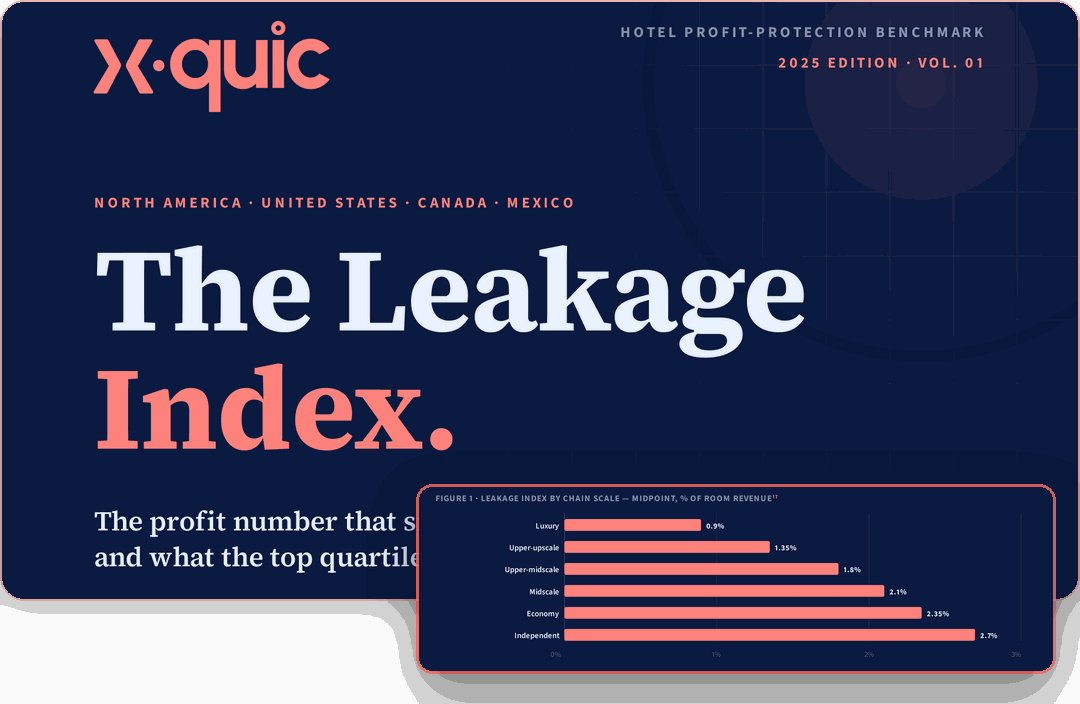
Most revenue leakage shows up first as an unreconciled line: an OTA commission on a stay that never happened, a virtual card that was never charged, a crew or direct bill invoice short-paid. Hotels typically lose 3–12% of revenue this way, which is why x·quic's OTA Commission 360° and Virtual Card 360° audit every reservation after checkout rather than sampling at month-end. A free 1-Year Profit Audit shows what your own close has been missing. See where hotels lose revenue for the full map.
Frequently asked questions
How long should a hotel month-end close take?
Many properties target 5 to 10 business days after month-end. The right number depends on staffing, systems and ownership reporting deadlines. Completeness should come before speed.
Who is responsible for the month-end close at a hotel?
Usually the controller or accounting manager, with the GM reviewing and signing off. At management companies, a regional or corporate finance team often reviews the package before it goes to ownership.
Should OTA commissions be paid exactly as invoiced?
Not without review. Match each line to a real, completed stay and the contracted commission rate first, then dispute anything that does not match within the OTA's dispute window.
What is the most commonly skipped month-end step?
Virtual card reconciliation. It sits between the front office and accounting, so it often belongs to no one, and uncharged cards expire quietly.
See your own leakage number.
Your free 1-year Profit Audit runs all six 360° audits on your own data and shows exactly what was lost and what is recoverable. No cost, no commitment, nothing to install.
Related guides


One email a month on where hotel profit leaks.
New guides, recovery data and what we are seeing across OTAs, crew lodging and payments. No spam; unsubscribe anytime.