OTA Reconciliation: The Complete Guide for Hotels

What OTA reconciliation is, the three records every OTA booking has to agree with, the errors that cost hotels money, and a month-end process you can run on any PMS.
Quick answer: OTA reconciliation is the process of matching what an online travel agency (Booking.com, Expedia, Agoda and others) billed or paid your hotel against what actually happened at the property and what your contract says. For every OTA reservation you compare three records: the OTA’s invoice or payout line, the realized folio in your PMS, and your contracted terms. Any line that does not agree, such as commission on a cancelled or no-show stay, the wrong commission rate, or a virtual card that was never charged, is a recoverable error, but only if you find it and dispute it inside the OTA’s window.
What is OTA reconciliation?
OTA reconciliation means proving, reservation by reservation, that the money flowing between your hotel and each online travel agency is correct. It answers three questions for every booking:
- Did we owe commission on this stay, and how much? (hotel-collect bookings, where the OTA invoices you afterward)
- Did we receive everything we were owed? (merchant-model bookings, where the OTA pays you or issues a virtual card)
- Does the amount follow the contract? (rate, basis, cancellation and no-show terms)
It is different from the night audit. The night audit confirms that your PMS balances against itself. OTA reconciliation checks your PMS against an outside party’s records, which the night audit never sees. See what the night audit misses for that gap in detail.
Why OTA reconciliation matters
An OTA invoice reflects the OTA’s view of a reservation, and a booking is not a stay. Guests cancel inside the window, no-show, shorten, extend, modify or get relocated, and the OTA’s commission logic does not always follow. Merchant-model payouts and virtual cards have their own timing, fees and expiration dates. None of that is visible in a PMS report.
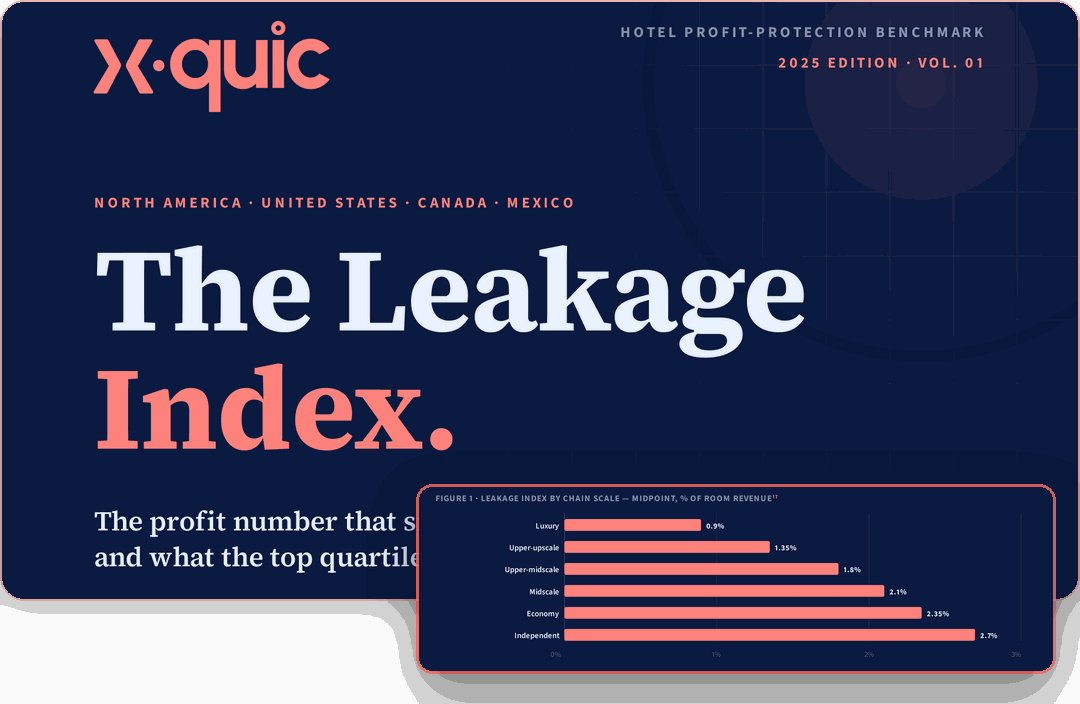
Hotels typically lose 3–12% of revenue to leakage, depending on the property, and OTA activity is one of the largest sources because the volume is high and the errors repeat every month. Most of these errors are small per reservation, which is exactly why they survive: nobody disputes a $40 line by hand, but hundreds of them a year add up to real money that has almost no cost attached when you get it back. For the full picture, read where hotels lose revenue and the true cost of OTA bookings.
The two OTA business models, and what to reconcile in each
Most OTAs offer two ways to take a booking, and each creates a different reconciliation job. Many hotels run both at once, sometimes on the same channel.
Hotel collect (agency model)
The guest pays the hotel at the property. The OTA then sends a commission invoice, usually monthly. Here OTA reconciliation is about what you pay: every commission line should match a stay that happened, on the right revenue, at the right rate.
OTA collect (merchant model)
The guest pays the OTA at booking. The OTA keeps its margin and pays the hotel the net amount, either by bank transfer or with a virtual credit card (VCC) the hotel has to charge. Here OTA reconciliation is about what you receive: every reservation should produce a payout or a virtual card charge for the right amount, before the card expires. See why OTA virtual cards go uncharged.
The three records every OTA reservation must agree with
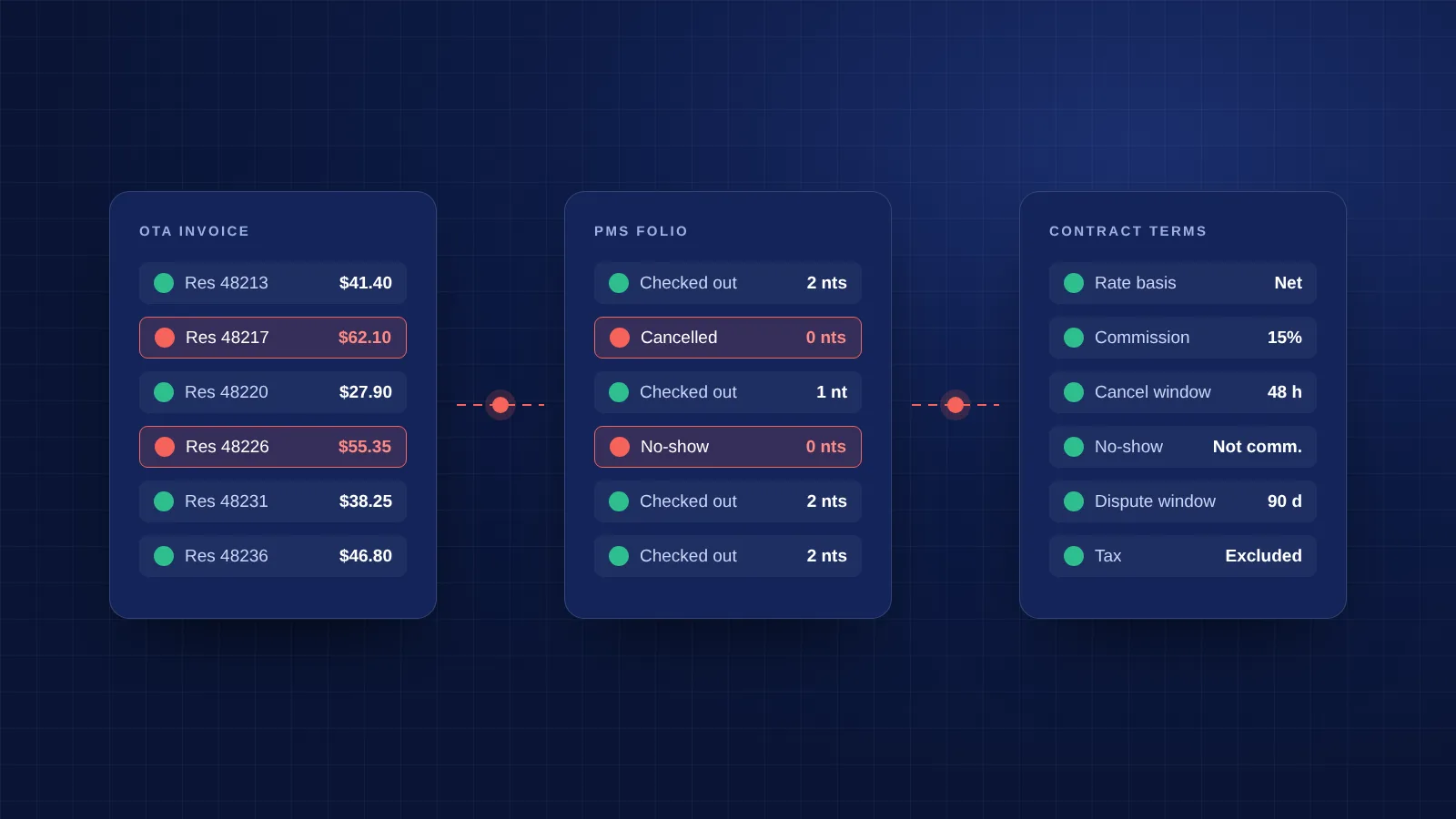
OTA reconciliation is a three-way match. For each reservation, line up:
- The OTA record: the commission line on the invoice (hotel collect), or the payout line and virtual card details (merchant model), from the OTA extranet or statement.
- The PMS record: the reservation and the realized folio: did the guest arrive, how many nights, what room revenue posted, and was anything refunded.
- The contract: your commission percentage, which revenue it applies to (for example, net of taxes and fees), and how cancellations, no-shows and modifications are treated.
Matching is usually done on the OTA confirmation number, with guest name and stay dates as a fallback when a reservation was re-keyed or modified. A line passes only when all three records agree. Everything else is an exception to investigate.
Common OTA reconciliation errors
These are the discrepancies that show up again and again when hotels start reconciling every line instead of sampling.
On commission invoices (what you pay)
- Commission on cancelled stays: the guest cancelled within terms, but the line is still on the invoice.
- Commission on no-shows: the guest never arrived and no revenue posted, yet commission is billed.
- Shortened stays: commission follows the nights booked, not the nights stayed.
- Wrong rate basis: commission calculated on a figure that includes taxes, fees or a pre-discount rate the contract excludes.
- Wrong percentage: a rate that does not match your agreement, often after a program or contract change.
- Duplicates and modifications: a changed reservation creates a second commissionable record.
- Fraudulent bookings: the reservation was fake and the stay never happened, but commission lands on the invoice like any other line. See OTA fraudulent bookings.
On payouts and virtual cards (what you receive)
- Virtual cards never charged: the card declines before its activation date, nobody retries, and it expires.
- Undercharged cards: an extra night, an upgrade or unposted taxes and fees leave part of the balance on the card.
- Payout shortfalls: a transfer that does not equal the sum of the stays it covers, net of the agreed margin.
- Penalties not collected: cancellation or no-show penalties payable on a prepaid booking that were never claimed.
For a deeper look at the commission side, read OTA commission overbilling.
How to reconcile OTA commissions and payouts, step by step
- Collect the statements. Download each OTA’s commission invoice and payout or virtual card report for the period, from every extranet you use.
- Export the PMS data. Pull reservations and folios for the same period, including cancellations, no-shows and modifications, not just checked-out stays.
- Match each OTA line to a reservation. Use the OTA confirmation number first, then name and dates. Anything that cannot be matched is its own exception.
- Test the outcome. For each match, compare the stay that actually happened (arrived, nights, posted revenue) with what the OTA billed or paid.
- Test the math against the contract. Recalculate the expected commission or payout using your percentage and rate basis, and flag differences beyond a small, documented tolerance.
- Build the dispute file. For each exception, attach the folio, the reservation history and the contract clause, so the dispute rests on your own records.
- Dispute inside the window. Submit disputes through each OTA’s process before its deadline, and charge any open virtual cards before they expire.
- Track to resolution. Log each dispute’s amount, status and outcome, and confirm the credit actually appears on a later invoice or payout.
For example (illustrative numbers only): a hotel receives a monthly OTA invoice with 600 commission lines. Matching finds 9 lines on stays that cancelled within terms, 4 on no-shows and 6 where commission was calculated on a figure that included taxes. At an average of $45 a line on the first two groups and $8 on the third, that is $633 of commission the hotel did not owe for one channel in one month, or more than $7,500 over a year, before counting virtual cards.
OTA reconciliation month-end checklist
- Every OTA invoice and payout for the period downloaded and saved.
- Every OTA line matched to a PMS reservation, with unmatched lines listed.
- Cancelled, no-show and shortened stays checked against commission billed.
- Commission recalculated on the contracted rate basis and percentage.
- Every merchant-model reservation matched to a payout or a charged virtual card.
- Virtual cards with an open balance charged before expiration.
- Disputes filed with documentation, each with a deadline and an owner.
- Credits from prior disputes confirmed on this period’s invoice or payout.
- Results recorded by channel, so recurring errors are visible month to month.
This fits inside the wider close; see our month-end close guide and financial controls checklist.
Why manual OTA reconciliation breaks down
The work sits between revenue management, accounting and the front desk, and none of them owns it. Statements arrive in different formats from every channel. The PMS does not know what the OTA billed. Checking hundreds or thousands of lines by hand is not realistic, so most hotels sample a few lines or pay the invoice as it is. Sampling does not fix the problem: the bulk of the variance sails through, and an invoice that is never questioned is never corrected.
Timing makes it worse. Dispute windows close and virtual cards expire on the OTA’s schedule, not at month-end, so an error found late is often an error that can no longer be recovered.
OTA reconciliation software vs. a recovery service
Once volume makes manual matching impractical, hotels usually choose between two approaches:
- Reconciliation software matches the data and produces an exception list. Your team still investigates, builds the dispute files, files the disputes and follows them up.
- A recovery service does the matching and the follow-through: it disputes the errors, charges the cards and reports what was actually recovered.
Whichever you choose, ask how often every reservation is checked (every line, not a sample), what access it needs (read-only is enough), whether each finding traces back to a source record, and how recoveries are reported. Our buyer’s guide to revenue recovery software lists the questions to ask.
How x·quic handles OTA reconciliation
OTA Commission 360° audits every OTA reservation 72 hours after check-out, matching each commission line to the realized folio and your contracted terms, and claws back commission billed on cancelled, shortened, no-show and fraudulent stays or at the wrong rate. Virtual Card 360° handles the merchant side, monitoring every prepaid OTA reservation 24/7 so each card is charged in full before it expires. Access is read-only, and every recovery is reported against the source records in one dashboard.
At The Watergate Hotel in Washington, this work has recovered over $100,000 since early 2023, including commission billed on fraudulent bookings. Read the Watergate Hotel story.
Frequently asked questions
What is OTA reconciliation in a hotel?
It is matching every OTA commission invoice, payout and virtual card to the reservation in your PMS and to your contract, so you pay only the commission you owe and collect everything you are owed.
How often should a hotel reconcile OTA activity?
At least monthly for commission invoices, and continuously or weekly for virtual cards, because cards expire and dispute windows close on the OTA’s schedule rather than at month-end.
Which OTAs need to be reconciled?
Every channel that bills commission or pays you, including Booking.com, Expedia, Priceline / Agoda, Trip.com, Hopper and Despegar. Smaller channels deserve the same check, because unwatched channels are where errors persist.
Can our PMS do OTA reconciliation?
Not on its own. The PMS knows what happened at the property but not what the OTA billed or paid. Reconciliation needs the OTA’s records alongside the PMS, compared line by line.
How far back can a hotel recover OTA commission errors?
It depends on each OTA’s dispute terms, so check your agreements. A first reconciliation of a full year of history usually shows how much was lost and how much is still inside a window to recover.
See your own OTA reconciliation, line by line.
Your free 1-year Profit Audit reconciles every OTA commission line and virtual card from the past year against the stays that actually happened, on your own data. No cost, no commitment, nothing to install.
Related guides

One email a month on where hotel profit leaks.
New guides, recovery data and what we are seeing across OTAs, crew lodging and payments. No spam; unsubscribe anytime.