AI in Hotel Finance: What It Can Do in the Back Office


Where AI and automation genuinely help hotel accounting teams, what to expect from them, and the controls owners should insist on.
Quick answer: AI and automation in hotel finance work best on high-volume, rules-heavy tasks: matching invoices to purchase orders and contracts, reconciling payments to reservations, flagging anomalies, and producing first-draft forecasts. They do not replace the controller. The realistic gain is fewer hours spent on routine matching and more attention on the exceptions that actually cost money.
What can AI actually do in a hotel back office today?
Today, the proven uses are pattern matching, data extraction and exception flagging, not autonomous decision-making. Most of what is marketed as "AI" in hotel accounting is a mix of rules engines, optical character recognition (OCR) and machine learning models that score how likely two records are to match.
Common, practical applications include:
- Invoice capture and coding: reading vendor invoices, extracting vendor, date, amount and line items, and suggesting a general ledger code.
- Two- and three-way matching: comparing invoices to purchase orders and receiving records, and routing mismatches for review.
- Payment reconciliation: matching card processor deposits, OTA payouts and bank lines to PMS transactions.
- Anomaly detection: flagging unusual refunds, duplicate vendor payments, rate overrides, or commission charges that do not fit a reservation's history.
- Forecasting support: producing a baseline revenue or labor forecast from historical data that a human then adjusts for groups, events and market knowledge.
- Drafting: summarizing variance explanations or month-end commentary for a controller to edit.
Where does automation save the most time for hotel finance teams?
The biggest time savings come from tasks that are repetitive, high-volume and rule-based. If a person does the same comparison hundreds of times a month, it is a candidate.
In most hotels that means accounts payable, credit card and OTA reconciliation, and the matching work inside the month-end close. It also includes auditing OTA commission invoices against reservation outcomes, where every cancelled, no-show or shortened stay is a potential overcharge. These are areas where volume overwhelms people, so errors slip through simply because nobody has time to check each line.
For example (illustrative numbers only): a management company processes 1,200 AP invoices a month across a small portfolio. At 6 minutes each, manual matching takes 7,200 minutes, or 120 hours. If automation matches 70% of invoices cleanly (840), staff review the remaining 360 exceptions. At the same 6 minutes each, that is 2,160 minutes, or 36 hours, a reduction of 84 hours a month. The real benefit is that those 36 hours go to the invoices most likely to be wrong.
What should owners realistically expect from AI in finance?
Expect faster processing and better coverage, not zero headcount or zero errors. AI tools are probabilistic: they are right most of the time, and they can be confidently wrong on unusual items.
Realistic expectations look like this:
- Match rates improve over time as rules and vendor mappings are refined. The first months usually produce more exceptions, not fewer.
- Data quality limits results. If PMS folios, rate codes or vendor master files are messy, automation will reproduce the mess faster.
- Forecasts from models are a starting point. They miss things a revenue manager knows, such as a city-wide event or a lost group.
- Generative AI tools can draft commentary, but numbers in any draft must be traced back to the ledger before anyone relies on them.
What controls do you need when automating finance tasks?
Automation needs the same controls as a human process, plus a few more. The core principle is that software can propose, but a named person approves anything that moves money or changes the books.
- Keep segregation of duties. The person or system that sets up vendors should not also approve payments. Confirm automated workflows do not collapse roles that your financial controls keep separate.
- Set approval thresholds. Auto-approve only low-value, fully matched items. Route anything above a dollar threshold, or any new vendor, to a person.
- Log every action. You should be able to see what the system matched, what rule it used, and who approved the result.
- Sample the auto-matched items. Periodically review a sample of transactions the system marked as clean. This is how you find rules that are quietly wrong.
- Control bank detail changes. Any change to vendor banking information should require verification through a known phone number, never through the email that requested it.
- Limit data access. Give tools read-only access where possible and remove access when a tool or vendor is retired.
For AI more broadly, the NIST AI Risk Management Framework is a voluntary, publicly available reference that some organizations use to think through how to govern and monitor AI systems. Your auditors and accountants can advise on what level of control documentation fits your ownership structure.
How should a hotel owner evaluate an AI finance tool?
Evaluate the tool on your own data, with your own exceptions, before committing. A demo on clean sample data tells you very little about how it will handle your PMS exports and your vendors.
- Ask what data it needs, in what format, and whether access is read-only.
- Ask how it handles items it cannot match, and who works those exceptions.
- Ask for the audit trail: can you see why each item was matched or flagged?
- Ask how results are measured: match rate, exceptions per month, dollars identified, dollars actually recovered.
- Check how it fits your existing technology stack and whether it adds another login and another source of truth.
How does back-office automation connect to revenue leakage?
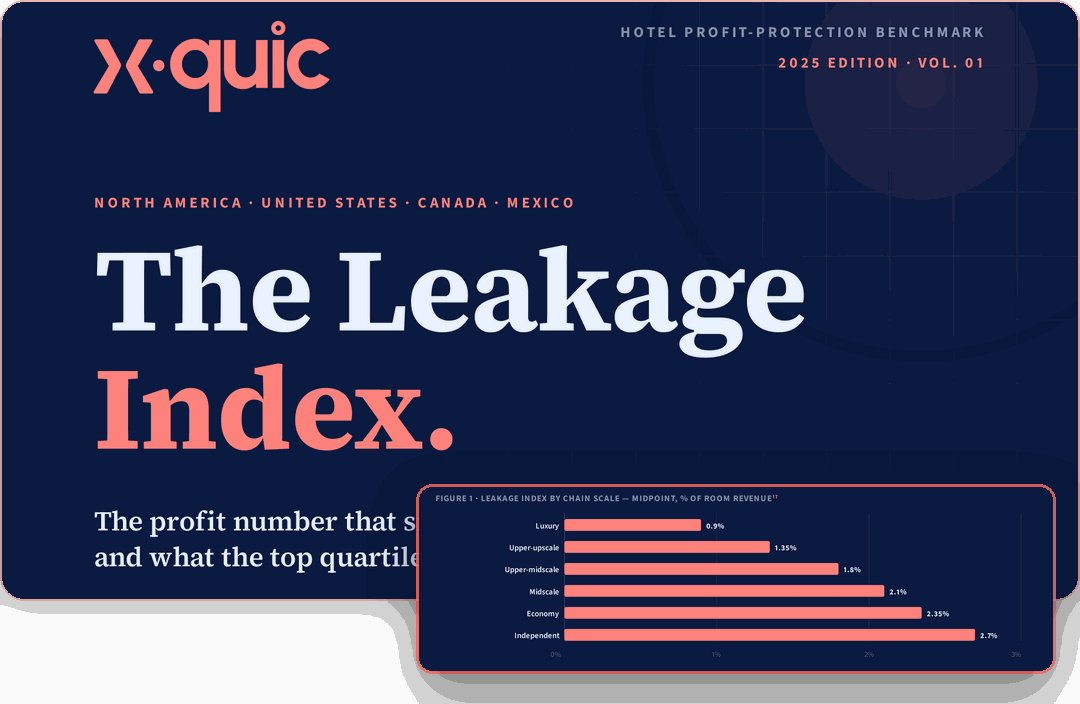
Revenue leakage is mostly a volume problem. Hotels typically lose 3–12% of revenue to leakage, depending on the property, often through OTA commission overbilling, uncharged virtual cards, missed no-show fees and lost chargebacks that nobody had time to check line by line. On a $4M hotel, that is $120,000 to $480,000 a year.
This is where automation earns its keep: checking every transaction rather than a sample. x·quic audits each reservation 72 hours after check-out through OTA Commission 360° and reconciles OTA virtual cards before they expire through Virtual Card 360°, working from read-only access to a hotel's data. See where hotels lose revenue for the full list of leak points.
Frequently asked questions
Will AI replace hotel accountants and controllers?
Not in any realistic near-term sense. It shifts their time from routine matching to reviewing exceptions, investigating variances and advising ownership. Judgment, vendor relationships and accountability for the numbers stay with people.
Is it safe to give an AI tool access to hotel financial data?
It can be, with the right controls: read-only access where possible, clear data handling terms, multi-factor authentication, and prompt removal of access when the relationship ends. Review terms with your attorney and IT advisor before granting access.
What is the best first process to automate?
Start with a high-volume reconciliation that has clear matching rules, such as card processor deposits or OTA commission invoices. Results are easy to measure, and errors are easy to spot.
Can small independent hotels benefit, or is this only for large portfolios?
Smaller hotels often benefit most, because they rarely have spare staff to audit every transaction. Many tools are priced per property. See our FAQ for how x·quic works with single properties.
See your own leakage number.
Your free 1-year Profit Audit runs all six 360° audits on your own data and shows exactly what was lost and what is recoverable. No cost, no commitment, nothing to install.
Related guides


One email a month on where hotel profit leaks.
New guides, recovery data and what we are seeing across OTAs, crew lodging and payments. No spam; unsubscribe anytime.