How to Evaluate a Hotel Management Company: Criteria and Questions


The criteria and questions owners should use to select or review a hotel management company, from fee alignment and reporting to revenue integrity, controls and references.
Quick answer: Evaluate a hotel management company on five things: how its fees align with your returns, how quickly and accurately it reports, how well it protects revenue after the guest checks out, the strength of its financial controls, and what its current owners say. Ask for sample reports, speak to references privately, and agree on the KPIs you will judge them by before you sign.
What should owners look for in a hotel management company?
Look for an operator whose incentives, reporting and controls line up with ownership's goals. Brand relationships and portfolio size matter, but they do not tell you how your hotel's money will be handled.
- Experience with your hotel type, brand and market.
- A fee structure that rewards profit, not just revenue.
- Timely, accurate, USALI-based financial reporting.
- Documented revenue integrity and collection processes.
- Strong internal controls and audit history.
- Stable leadership at the property and regional level.
- References from owners who have worked with them through a difficult year.
How are hotel management fees usually structured?
Most agreements combine a base fee, usually a percentage of total revenue, with an incentive fee tied to profit, plus accounting fees and reimbursable expenses. Percentages, thresholds and definitions vary widely by deal, so compare actual dollars, not headline rates, and have your attorney review the agreement.
For example (illustrative numbers only): on a hotel with $4,000,000 of total revenue and $1,500,000 of GOP:
- Company A charges a 3% base fee: $120,000.
- Company B charges a 2.5% base fee ($100,000) plus an 8% incentive fee on GOP above $1,200,000 (8% × $300,000 = $24,000), for a total of $124,000.
Company B costs $4,000 more at this level of profit but earns less if GOP falls, so its incentives are more closely tied to yours. Also check which fees sit outside the headline: accounting fees, technology charges, centralized services and reimbursables can add up.
What does good hotel financial reporting look like?
Good reporting is on time, consistent month to month, and explains variances without being asked. You should never have to request the same schedule twice.
- A month-end package delivered on a fixed date each month.
- P&L in USALI format with budget, prior-year and forecast columns.
- Balance sheet reconciliations, AR aging and a cash summary.
- Written commentary on significant variances.
- STR or comparable competitive set data.
Ask how the package is prepared: who closes the books at property level, who reviews it at the regional level, and how often balance sheet accounts are reconciled. Late or inconsistent reporting is often the first visible sign of weak accounting staffing.
Ask each candidate for a redacted sample month-end package from a comparable hotel. See our month-end close guide for what should be in it.
How can you tell if a management company protects revenue?
Ask how it confirms that every dollar earned is collected. Many operators focus on selling rooms well and less on what happens after check-out, where commissions, virtual cards, fees and chargebacks are won or lost.
- Who audits OTA commission invoices against actual stays, and how often?
- How do you ensure every OTA virtual card is charged before it expires?
- What is your chargeback win rate, and who builds the evidence?
- How are no-show and cancellation fees monitored?
- How do you reconcile direct bill and crew invoices?
- How do you report revenue leakage to owners?
Our article on where hotels lose revenue lists the areas to probe.
What internal controls should a management company have?
At minimum: segregation of duties, daily revenue reconciliation, approval limits, and regular internal audits. Ask to see the policies, not just hear about them.
- Separate people for posting payments, approving adjustments and reconciling bank accounts.
- Daily PMS-to-deposit reconciliation with sign-off.
- Written approval thresholds for rate overrides, comps and write-offs.
- Internal audit visits and how findings are reported to owners.
Compare their answers to our hotel financial controls checklist.
Which questions should you ask management company references?
Ask references about a bad month, not a good one. Anyone can report well when results are strong.
- How did they communicate when results missed budget?
- Were month-end packages ever late or restated?
- How did GM or controller turnover affect your hotel?
- Did you ever find revenue they missed?
- Would you hire them again for your next hotel?
Ask for references from owners who have left them, too. A company that can point you to a former client who still speaks well of them usually handled the exit professionally, which tells you a lot about how it will treat your hotel.
Which KPIs should you use to evaluate a management company?
Agree on a short list before signing and review it quarterly: RevPAR index against the competitive set, GOP margin, flow-through, labor cost as a share of revenue, distribution cost, AR aging and leakage rate. Our guide to hotel asset management KPIs defines each one.
Write the KPIs, targets and review cadence into the agreement or a side letter where possible. Performance tests that are defined up front are far easier to enforce than expectations raised after a weak year. Confirm the wording with your attorney.
How does revenue leakage affect your choice of operator?
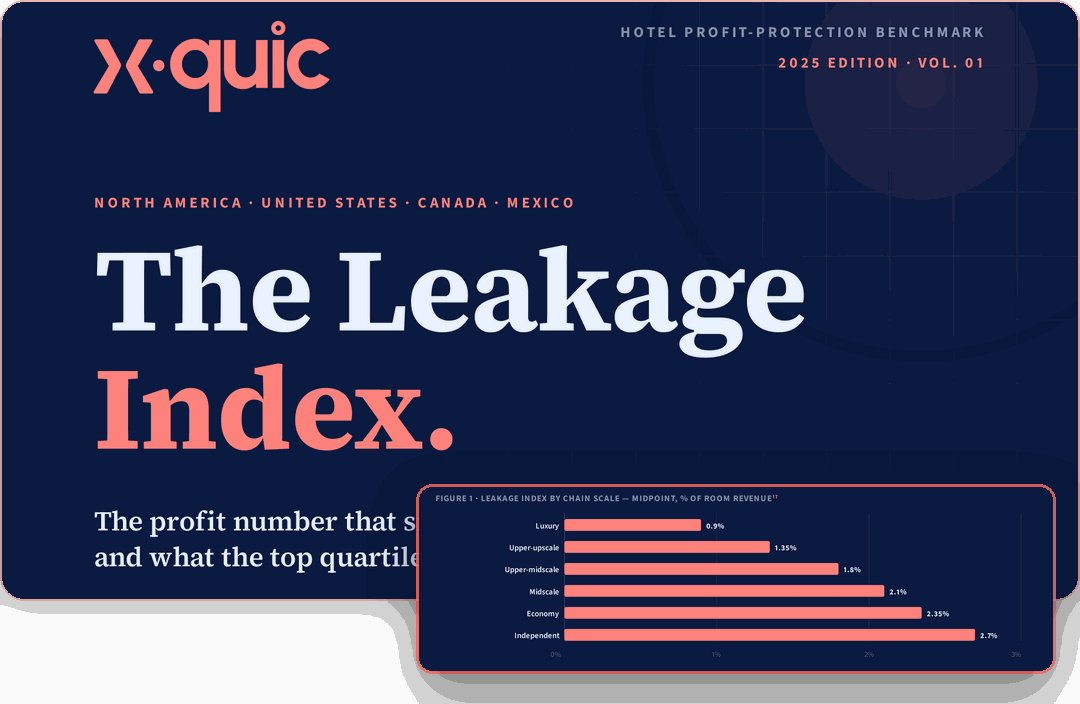
Leakage is where two operators with similar RevPAR can produce very different profit. Hotels typically lose 3–12% of revenue to leakage, so ask how each candidate measures and recovers it. x·quic gives management companies one dashboard across their portfolio, with role-based views for GMs, controllers, asset managers and ownership, which lets owners see recovery results directly.
Frequently asked questions
What is a typical hotel management fee?
Structures vary by hotel type, brand and deal. Most combine a base fee on revenue with a profit-based incentive fee. Compare total dollars under realistic scenarios and confirm terms with your attorney.
How long are hotel management agreements?
Terms vary widely. Pay as much attention to termination rights, performance tests and termination fees as to the length.
Should the management company or the owner audit OTA commissions?
Either can, but someone must own it. Agree in writing who reviews commissions and how results are reported.
Can I evaluate my current operator the same way?
Yes. Run the same questions and KPIs on your current company. If results fall short, see switching hotel management companies.
Know what every hotel in the portfolio is leaking.
Run the free 1-year Profit Audit across your properties, including any hotel you are taking over, and see leakage by hotel, brand, and product in your own numbers. No cost, no commitment.
Related guides



One email a month on where hotel profit leaks.
New guides, recovery data and what we are seeing across OTAs, crew lodging and payments. No spam; unsubscribe anytime.