Hotel Acquisition Due Diligence Checklist: Financial and Operational


What to verify before you buy a hotel: revenue against bank deposits, OTA commissions, receivables, the franchise and PIP, the management agreement, systems access and leakage.
Quick answer: Hotel acquisition due diligence should test whether the revenue on the seller's P&L actually reached the bank, whether the costs that sit against it (OTA commissions, franchise fees, management fees) match the contracts, and whether the systems and agreements you inherit will let you run the hotel on day one. Start with a trailing-twelve-month P&L tied to bank deposits, then work through distribution contracts, receivables, the franchise and PIP, the management agreement, and a leakage review.
What does financial due diligence on a hotel actually cover?
It covers the quality of earnings: whether reported revenue and expenses are real, recurring and correctly recorded. A broker package shows you the story the seller wants told. Due diligence tests that story against source records.
For most select-service and full-service deals, the core financial workstreams are:
- Trailing-twelve-month (T-12) and prior two years of monthly P&Ls, ideally in the USALI (Uniform System of Accounts for the Lodging Industry) format so departments and undistributed expenses are comparable to other hotels.
- Night audit and PMS revenue reports for the same periods.
- Bank statements for every operating and credit card clearing account.
- Accounts receivable aging, including direct bill and city ledger.
- OTA contracts, commission invoices and virtual card statements.
- Franchise agreement, PIP (property improvement plan) and quality assurance reports.
- The management agreement, if the hotel is third-party managed.
- Payroll registers, union or staffing agreements, and open vendor contracts.
How do you verify hotel revenue against bank deposits?
Trace revenue from the PMS to the general ledger to the bank. Every dollar of room revenue should show up as a card settlement, a cash or check deposit, an OTA payout, a virtual card charge, or an open receivable.
- Pull monthly room and total revenue from the P&L.
- Pull the same months from PMS revenue reports and confirm they agree.
- Sum deposits by source: card processor settlements, OTA payouts, direct bill payments, cash and checks.
- Adjust for timing: revenue earned in one month is often collected in the next.
- Explain every remaining gap in writing.
For example (illustrative numbers only): a seller reports $3,200,000 of T-12 room revenue. After timing adjustments, traced deposits and open receivables total $3,150,000. The $50,000 difference is about 1.6% of room revenue. That gap might be uncollected OTA virtual cards, write-offs, or simple misposting, but you want to know which before you close, because it affects both the purchase price and your year-one plan.
What should you look for in OTA contracts and commission statements?
Look for whether the hotel is paying the commission rates it agreed to, only on stays that actually happened. OTA commission is often one of the largest variable costs on a select-service P&L, and billing errors are common.
- Get the signed contract or current terms for each OTA and note the contracted commission rates and any promotional program add-ons.
- Sample commission invoices and match them to reservations: were commissions charged on cancellations, no-shows or shortened stays?
- Check virtual card (OTA-collect) reservations: were the cards charged in full before they expired?
- Confirm who controls the extranet logins and whether they transfer at closing.
Our guides on OTA commission overbilling and uncharged virtual cards walk through what these errors look like in practice.
How should you review accounts receivable in a hotel acquisition?
Review AR aging by account and by age bucket, and decide before closing who owns each balance. Old receivables are frequently overstated, and the purchase agreement should say clearly whether AR transfers, stays with the seller, or is prorated.
- Flag any balance over 90 days and ask for collection history.
- Look for large direct bill accounts (crew, corporate, government, group) and read their contracts.
- Compare AR to deposits after the aging date: did the balances actually get paid?
- Identify credit balances and guest deposits you will be expected to honor.
See hotel accounts receivable and direct bill for a deeper process.
What franchise and PIP issues can change the deal?
A change of ownership usually triggers the brand's transfer process, which can include a new franchise agreement, application fees and a PIP. The PIP can be the single largest capital item in the first two years, so price it before you commit.
- Request the current franchise agreement and ask the brand what the transfer process requires. Confirm terms directly with the brand and your attorney.
- If you are signing a new franchise agreement, the franchisor generally must provide a Franchise Disclosure Document under the FTC Franchise Rule. Read the fee items carefully.
- Get contractor estimates for the PIP, not just the brand's scope list.
- Review recent quality assurance scores and guest satisfaction trends.
For a plain-English overview of royalty, marketing and program fees, read hotel franchise fees explained.
What should you check in the existing management agreement?
Check whether you can terminate it, what it costs to do so, and what data and systems belong to the owner. Some agreements survive a sale; others can be terminated on sale with notice or a fee.
- Term, renewal and termination-on-sale provisions, including notice periods and termination fees.
- Fee structure: base fee, incentive fee, accounting fees and reimbursables.
- Who owns the guest data, accounting records and system licenses.
- Required transition cooperation from the outgoing operator.
If you plan to change operators, switching hotel management companies covers the handover in detail.
Why does systems access matter before closing?
Because you cannot collect revenue on day one if you cannot log into the systems that hold it. Build a systems inventory during diligence and make access transfer a closing deliverable.
- PMS, POS and channel manager (vendor, license owner, admin users).
- OTA extranets and brand portals.
- Merchant accounts and payment gateways.
- Accounting system, bank portals and payroll platform.
- Direct bill and corporate lodging portals.
How does a leakage review fit into hotel due diligence?
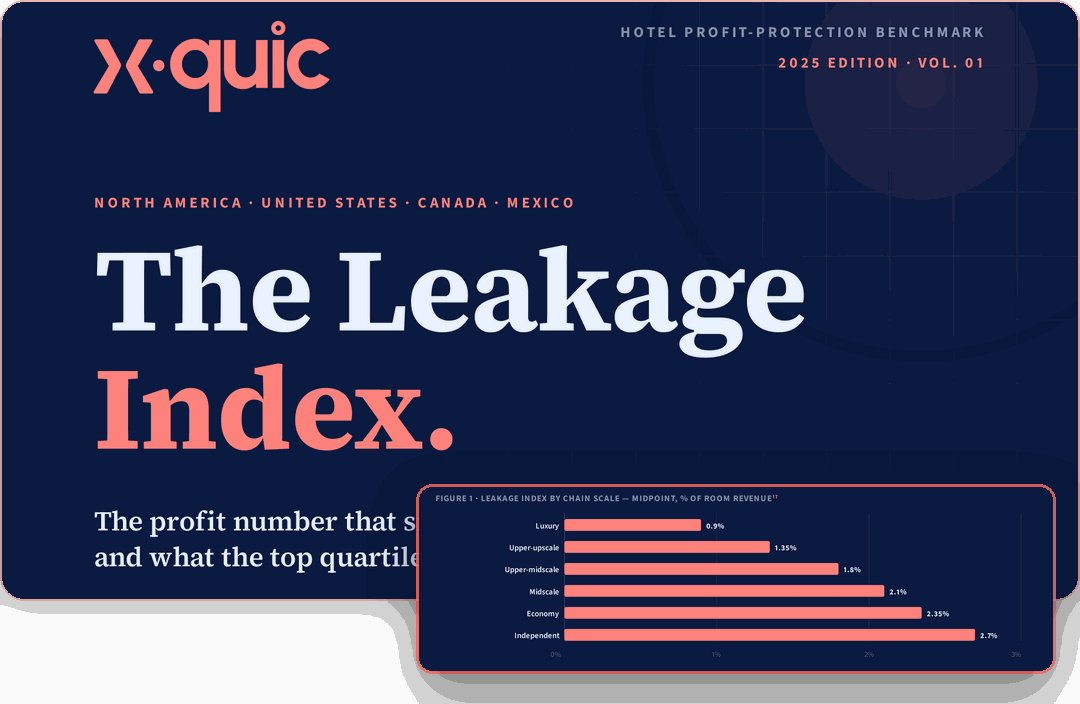
A leakage review looks for revenue the hotel earned but never collected, and costs it paid but did not owe. Hotels typically lose 3–12% of revenue to leakage, so on a $4M hotel that is $120,000 to $480,000 a year, which is material to any valuation.
x·quic offers a free 1-Year Profit Audit on the hotel's own data, with read-only access and nothing to install. For buyers and new operators, our management company platform covers every reservation you inherit (past, current and future) so errors made under the prior operator can be recovered from day one.
Frequently asked questions
How long does hotel acquisition due diligence take?
It depends on the deal and the purchase agreement, but many buyers work within a diligence period of several weeks. Request the data room list on day one, because bank statements and OTA records are usually the slowest items to arrive.
Should I rely on the seller's P&L?
Use it as a starting point, not a conclusion. Tie it to PMS reports and bank deposits, and have your accountant review the quality of earnings before you close.
Who gets receivables when a hotel is sold?
Whatever the purchase agreement says. Negotiate it explicitly, and confirm the treatment with your attorney and accountant.
Can I find leakage before I own the hotel?
Often, yes, if the seller grants read-only access to reservation and billing data. Ask for it early in the diligence period.
Know what every hotel in the portfolio is leaking.
Run the free 1-year Profit Audit across your properties, including any hotel you are taking over, and see leakage by hotel, brand, and product in your own numbers. No cost, no commitment.
Related guides


One email a month on where hotel profit leaks.
New guides, recovery data and what we are seeing across OTAs, crew lodging and payments. No spam; unsubscribe anytime.