Where Select-Service Hotels Lose Money (and How to Stop It)

Lean staffing is the select-service model's strength, and also where the leaks hide. Here are the common places limited-service hotels lose money and a simple way to close them.
Quick answer: Select-service and limited-service hotels lose money mostly in the back office, not the lobby. The common leaks are OTA commission billed on stays that never happened, virtual cards left uncharged, no-show and cancellation fees waived or missed, chargebacks lost by default, slow direct bill collections and brand fees calculated on revenue that was never received. Lean staffing makes these leaks easy to miss.
Why are select-service hotels especially exposed to revenue leakage?
Because the same small team runs the desk, the night audit and the accounting. When a GM is also the controller and the front desk agent is also the night auditor, reconciliation is the first task to slip.
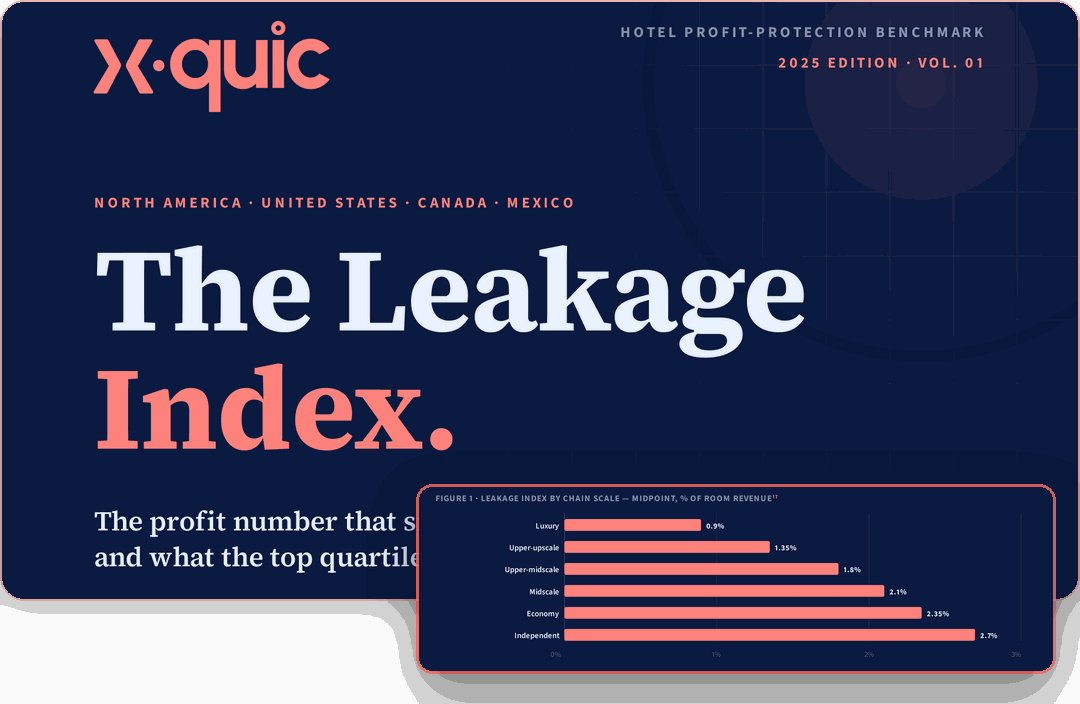
Many owner-operated select-service hotels, including many run by AAHOA members, keep payroll tight by design, and often run several properties from one small office. That is sound economics. But it means there is rarely a person whose full-time job is matching OTA statements, chasing receivables or building chargeback evidence. Across properties, leakage typically runs 3–12% of revenue.
For example (illustrative numbers only): a 90-room hotel running 70% occupancy at a $120 ADR sells 22,995 room nights a year (90 x 0.70 x 365), producing $2,759,400 in room revenue. Leakage of 3%, the low end of the typical range, is $82,782 a year. For a select-service hotel, that can be the difference between a thin year and a solid one.
None of these leaks show up as a line item. They sit in the gaps between the PMS, the OTA extranet, the card processor and the brand's reports, which is why each system can look correct while money is still missing.
Where do OTA bookings cost select-service hotels the most?
In commission paid on stays that did not happen as booked, and in virtual cards that were never charged. Both are common where the desk handles cancellations and early departures without updating the OTA.
- Commission billed on cancellations, no-shows and early departures.
- Commission on fraudulent reservations.
- Virtual cards charged before activation, charged short or allowed to expire.
The fix is a post-stay check of every OTA reservation: did the guest arrive, how many nights did they stay, and does the invoice match? On virtual cards, confirm the activation date and authorized amount before charging, and charge the full amount, including any extensions the OTA covers. See OTA commission overbilling for the patterns to look for.
Are no-show and cancellation fees being collected?
Often not consistently. Fees are waived to avoid a confrontation, forgotten on a busy morning or charged to a card that was never guaranteed.
For example (illustrative numbers only): a hotel with six eligible no-shows a month at $120 each that are never charged loses $720 a month, or $8,640 a year. The policy existed. The process did not. See the no-show and cancellation fee guide.
How do chargebacks drain select-service profit?
Chargebacks drain profit when disputes go unanswered or are answered without the right evidence. A small team may not see the notice in time, or may not know what the card network needs.
Keeping signed registration cards, ID checks, folios and guest communications in one place makes most disputes defensible. Log every notice the day it arrives, with its deadline, and assign one person to respond. See how to win more chargebacks.
What other cost traps are specific to lean-staffed hotels?
Beyond the front desk, a few traps show up again and again in select-service properties.
- Direct bill drift: Crew, corporate and government accounts go unpaid past 60 or 90 days because nobody owns follow-up. A simple aging report reviewed weekly prevents most of it.
- Contract rate mismatches: Negotiated or contracted rates are billed or paid at the wrong amount, including CLC® and crew lodging.
- Night audit gaps: The audit closes the day, but it does not confirm that OTA, card and contract records agree. See what the night audit misses.
- Fees on uncollected revenue: Franchise fees are generally calculated on reported revenue. Revenue booked but never collected may still carry fees, depending on your agreement. See hotel franchise fees explained.
- Travel agent commissions: Commissions owed or paid without tracking, so the hotel either overpays or damages an agent relationship by missing payments.
- Staff turnover: When the one person who knew the OTA dispute process leaves, the process often leaves with them. Write it down.
What is a simple monthly checklist to stop the leaks?
Assign one owner for each line and review it monthly with the GM.
- Match every OTA invoice line to the actual stay and dispute errors.
- Confirm every virtual card was charged in full after activation and before expiry.
- Review every no-show and late cancellation for fee eligibility and document waivers.
- Log every chargeback notice with its response deadline.
- Age direct bill receivables and call anything past 30 days.
- Check contracted and crew rates against what was billed and paid.
If a line cannot be staffed, that is a signal to automate it rather than skip it. A missed month is usually a lost month, because many dispute and card windows close quickly.
How x·quic helps lean teams close the gaps
x·quic does the reconciliation work a lean team cannot staff: OTA Commission 360°, Virtual Card 360°, No-Show / Cancel Fee 360°, Credit Card Chargeback 360°, CLC® Secure 360° and Travel Agent 360°. Hyatt Place Nashville Airport recovered $19,755 across two leak surfaces. The Free 1-Year Profit Audit runs on your own data, with nothing to install. See more on our customer stories page.
Frequently asked questions
What is the difference between select-service and limited-service hotels?
Both run with limited food and beverage and lean staffing. Select-service usually adds a few amenities, such as a small bar or grab-and-go market. The leakage risks are largely the same.
Why don't management reports show these losses?
Because most leaks are gaps between systems, such as the PMS, OTA extranet and card processor. Each system looks correct on its own.
Can a small hotel afford a revenue audit?
x·quic's Free 1-Year Profit Audit has no cost and no commitment, with no setup fees and no long-term lock-in if you continue.
See your own leakage number.
Your free 1-year Profit Audit runs all six 360° audits on your own data and shows exactly what was lost and what is recoverable. No cost, no commitment, nothing to install.
Related guides


One email a month on where hotel profit leaks.
New guides, recovery data and what we are seeing across OTAs, crew lodging and payments. No spam; unsubscribe anytime.