Revenue Recovery for Hotel Management Companies: A Portfolio Playbook


Across a portfolio, leakage becomes one of your largest controllable line items. Here is how to run recovery as a system, not a project.
Quick answer: Revenue recovery for a hotel management company means running the same leakage audit at every property, regardless of brand or PMS, and rolling the results into one view that GMs, controllers, asset managers and ownership can each act on. The playbook: standardize the six leak categories, set one monthly cadence, audit every acquisition from day one, and report recovered dollars to ownership the same way you report RevPAR.
At one hotel, revenue leakage is a controller's problem. Across a portfolio, it is a management company's reputation. Owners compare you to the last operator and the next one. Recovering money they did not know they were missing is one of the fastest ways to show value, and one of the easiest to scale if you build it as a system instead of a project.
Why is revenue leakage harder to control across a portfolio?
Leakage is harder to control across a portfolio because every property has a different PMS, different contracts, different channel mix and a different person responsible. What gets checked depends on who is on staff that month.
- Mixed systems. One hotel runs Opera Cloud, another OnQ, another Choice Advantage or Cloudbeds. Reports do not line up.
- Mixed business. A resort's leaks are OTA commissions and chargebacks. A highway select-service's leaks are crew billing and no-show fees.
- Turnover. The night auditor who knew how to reconcile virtual cards leaves, and nobody notices for six months.
- No common definition. "Recovered revenue" means something different at each property, so it cannot be rolled up or compared.
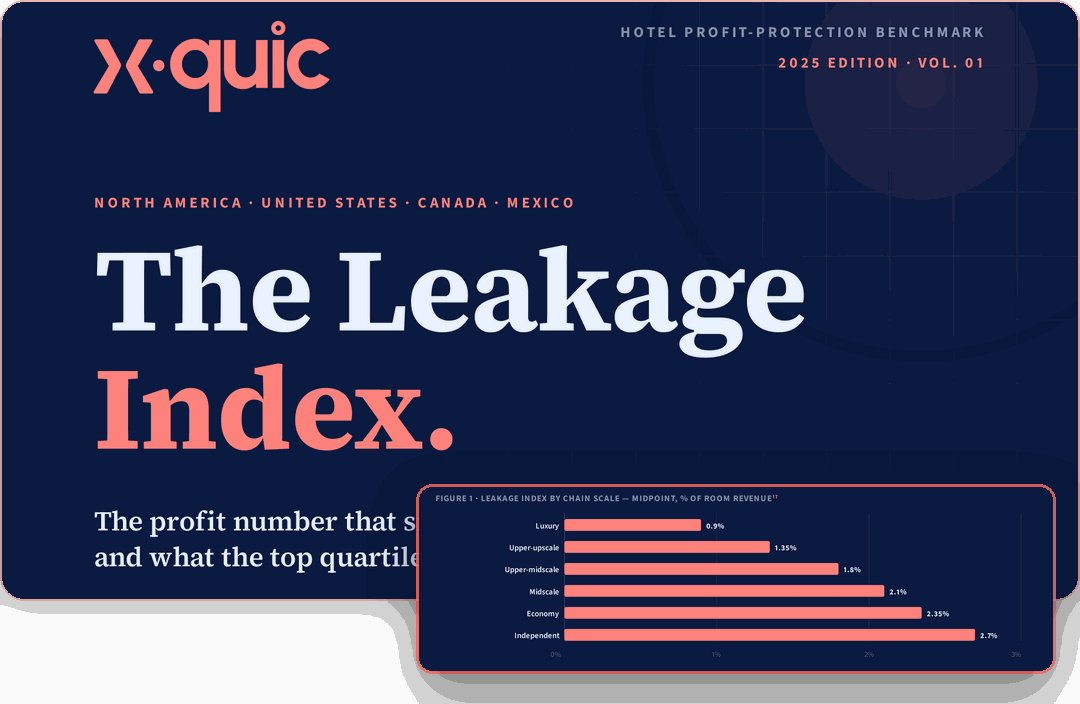
Hotels typically lose 3–12% of revenue to leakage, depending on the property. On a $4M hotel that is $120,000 to $480,000. Multiply by a portfolio and it becomes one of the largest controllable line items you manage.
How do you standardize revenue recovery across brands and PMS?
Standardize on the leak categories, not on the systems. Every hotel, whatever its PMS, leaks in the same six places. Define them once and measure every property against them.
- OTA commissions: invoices matched to contracted terms; commissions on cancelled, no-show, fraudulent or shortened stays disputed.
- OTA virtual cards: every card reconciled to its booking and charged in full before it expires.
- Crew and contract lodging: CLC® and other crew or government stays audited against how each contract pays.
- No-show and cancellation fees: every eligible fee identified and collected.
- Chargebacks: evidence submitted on time for every dispute.
- Travel agent commissions: agent commissions tracked through to payment, so nothing is left unresolved.
Then set one monthly cadence: same close date, same exception categories, same aging buckets, same report. The property team works exceptions; the corporate team watches trends. For the full breakdown of each leak, see where hotels lose 3–12% of revenue.
What should each role see?
Each role should see the level of detail it can act on. A GM needs this week's exceptions. Ownership needs recovered dollars and trend.
- GMs: open items at their property by category and age, with the specific reservations to fix.
- Controllers: recovered and outstanding amounts by property, AR aging on crew and direct bill, and which properties are falling behind the cadence.
- Asset managers: leakage as a percent of revenue by property, compared across the portfolio, so outliers get attention.
- Ownership: recovered dollars by period and by category, and what changed as a result.
Role-based views matter because the same data shown to everyone gets ignored by everyone. See how this works for groups on the management companies page.
What should you do when you take over a new hotel?
Audit its history immediately. When you take over operations, you inherit every reservation (past, current and future), plus whatever the prior operator mis-collected. Some of that money is still recoverable if you move before time limits run out.
- Get read-only data access in the first week. PMS, OTA extranets, crew programs, and the card processor.
- Look back as far as recovery is still possible. Unused virtual cards, uncollected no-show fees, OTA commissions billed on stays that did not happen, and unbilled crew nights all have different windows.
- Separate inherited items from new ones. Ownership should see what the prior operator left behind and what you recovered from it.
- Load future reservations into the standard process. Anything already booked through OTAs or crew contracts should be tracked from its first night.
- Fix the upstream causes. Rate codes, folio routing, cancellation policy settings and card-charging steps, so the same leaks do not recur.
This is one of the most visible early wins a new operator can deliver. It is concrete, it is cash, and it shows the owner what they were missing.
How should you report recovered revenue to ownership?
Report recovered revenue as a standing line in the monthly owner report, by category, with a running total. Keep it separate from normal operating revenue so it is clearly credited.
- Recovered this month and year to date, by the six categories.
- Outstanding items being worked, with expected value.
- Leakage rate trend (identified leakage as a percent of revenue).
- Root causes fixed this month.
For example (illustrative numbers only): a management company runs 12 hotels averaging $5M in revenue. If the portfolio's leakage sits at 4% and a standardized process cuts it to 1.5%, that is 2.5% of $60M, or $1.5M a year back to owners. Even a one-point improvement is $600,000.
What do real results look like?
Results vary by property, but they are usually meaningful. Hotel Nikko San Francisco reclaimed $115,876 and 300+ hours (read the story). The Watergate Hotel recovered over $100,000, including commissions on fraudulent bookings (read the story). Hotel Californian recovered $73,412 in 11 months, and Hyatt Place Nashville Airport recovered $19,755 across two leak surfaces. More on the customer stories page.
Should you build this in-house or use a partner?
Build in-house if you have the staff to run every category, every month, at every property, and to keep up with each channel's and contract's rules. Use a partner if that is not realistic, or if you want corporate visibility without adding headcount.
Questions to ask any partner:
- Does it work with every PMS in our portfolio?
- Does it cover all six categories, including crew lodging?
- Can each role get its own view?
- Can it audit an acquisition's history, not just go forward?
- What access does it need, and what does setup take?
- Is there a long-term lock-in?
How x·quic helps management companies
x·quic gives groups one dashboard for 1 to 1,000+ properties, with role-based views for GMs, controllers, asset managers and ownership, and works with PMS including Opera and Opera Cloud, OnQ, Choice Advantage, HotelKey, Cloudbeds, SynXis Property Hub and more. Each group gets a dedicated account manager, and new acquisitions are covered from day one. Start with a free 1-Year Profit Audit on one property or several; details are on the management companies page and the FAQ.
Get one number for your whole portfolio.
Run the free 1-year Profit Audit across your properties and see leakage by hotel, brand, and product in your own numbers. No cost, no commitment.
Related guides


One email a month on where hotel profit leaks.
New guides, recovery data and what we are seeing across OTAs, crew lodging and payments. No spam; unsubscribe anytime.