What Hotel Lenders Look For: NOI, DSCR, Debt Yield and LTV


How lenders read a hotel: the quality of NOI, DSCR, debt yield and LTV, the operator behind it, and financials clean enough to trust.
Quick answer: Hotel lenders focus on how much reliable cash flow the property produces and how well it covers the loan. They look at the quality and trend of net operating income (NOI), debt service coverage ratio (DSCR), debt yield, loan-to-value (LTV), the operator's experience and whether the financials are clean enough to trust. Definitions and thresholds vary by lender, so confirm how yours calculates each one.
Why does NOI quality matter as much as NOI size?
Lenders care whether NOI is repeatable. A number built on one-time items, deferred maintenance or unusually strong months will be adjusted down in underwriting.
NOI is generally revenue minus operating expenses, before debt service, depreciation and income taxes. Lenders commonly deduct a management fee and an FF&E reserve even if you self-manage or do not fund one, so their NOI may be lower than yours. Ask how they define it.
- Trend: is NOI stable or growing over the trailing 12 months and prior years?
- Mix: how much depends on a single contract, group or crew account?
- Margins: are expenses in line with similar hotels, and is flow-through consistent? See GOP flow-through explained.
- Adjustments: are one-time items clearly identified and explained?
What is DSCR and how is it calculated?
Debt service coverage ratio is generally NOI divided by annual debt service (principal and interest). It shows how many times the property's cash flow covers the loan payments.
A DSCR of 1.00 means NOI just covers the payments. Anything below that means the owner is funding part of the debt service from outside the hotel. Lenders set their own minimums, often with a cushion above 1.00, and may test it at closing and during the loan. Some loans include cash management or other remedies if coverage falls below a set level. Your loan documents will state the exact definition, the test dates and what happens if you miss it.
What are debt yield and LTV?
Debt yield is generally NOI divided by the loan amount, expressed as a percentage. Loan-to-value (LTV) is generally the loan amount divided by the property's appraised value. Both are ways for the lender to size the loan against the risk.
Debt yield does not depend on the interest rate or amortization, which is why many commercial lenders use it as a check on loan size when rates move. It answers a simple question: if the lender had to take the hotel back, what return would the current NOI produce on the money it lent?
LTV measures the owner's equity cushion. A lower LTV means more owner money in the deal and less risk for the lender. Because the value comes from the appraisal, and hotel appraisals lean heavily on income, weak or unclear NOI can reduce value and push LTV up even when the purchase price is fixed. Appraisers and lenders may also consider the brand, the franchise term remaining and any upcoming PIP, since those affect future cash flow.
How do the numbers fit together in an example?
For example (illustrative numbers only): a select-service hotel has underwritten NOI of $1,200,000. The owner requests a $12,000,000 loan with annual debt service of $950,000, and the hotel appraises at $16,000,000.
- DSCR: $1,200,000 / $950,000 = about 1.26x.
- Debt yield: $1,200,000 / $12,000,000 = 10.0%.
- LTV: $12,000,000 / $16,000,000 = 75%.
Now suppose the lender's underwriting removes $100,000 of one-time revenue, lowering NOI to $1,100,000. DSCR falls to about 1.16x ($1,100,000 / $950,000), and debt yield falls to about 9.2% ($1,100,000 / $12,000,000). If those results miss the lender's minimums, the loan amount may be reduced. This is why documented, recurring NOI is worth more than a higher but unexplained number.
How much does operator experience matter?
A great deal. Lenders are lending against a business, not only a building, and they want confidence the hotel will be run well through a downturn.
Expect questions about your history with similar hotels, your net worth and liquidity, your brand relationships, who will manage the property and how you handled past challenges. If you are newer to ownership, a strong third-party manager or experienced partner can help. See buying your second hotel.
What makes financials "clean" to a lender?
Clean financials are complete, consistent and reconcilable: the P&L ties to bank statements and tax returns, the same accounts are used month to month, and unusual items are explained.
- Monthly P&Ls in a consistent format, for at least the trailing 12 months and prior years.
- STR or comparable-set reports showing market position.
- A current receivables aging with direct bill balances explained.
- Bank reconciliations that tie to reported revenue.
- A capital expenditure history and any PIP. See the PIP planning guide.
- Franchise agreement and key contracts.
The financial controls checklist helps prepare these.
How does revenue leakage affect what a lender sees?
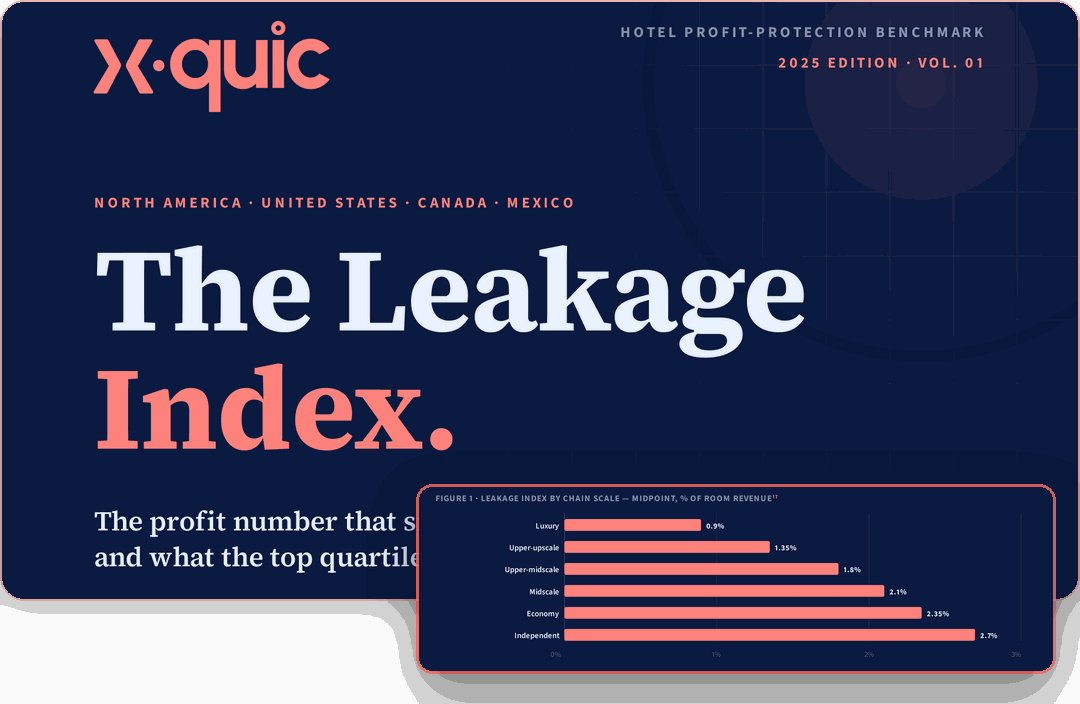
Revenue you earned but never collected, such as uncharged virtual cards, overbilled OTA commissions or lost chargebacks, lowers NOI directly, and every dollar of NOI flows through to DSCR, debt yield and value. Recovering it before you refinance or sell is one of the more practical ways to improve the numbers, and a documented recovery process also shows a lender that controls are in place.
x·quic's Free 1-Year Profit Audit runs on your own data with read-only access and shows where money was lost. See where hotels lose revenue and our FAQ.
Frequently asked questions
What DSCR do hotel lenders require?
It varies by lender, loan type and market conditions. Ask your lender for its minimum and exactly how it calculates NOI and debt service.
Is debt yield the same as cap rate?
No. Debt yield divides NOI by the loan amount; a cap rate divides NOI by property value. They use the same numerator but answer different questions.
Will a lender use my NOI or its own?
Usually its own. Lenders typically adjust for management fees, reserves and one-time items. Reconcile your figures to theirs early.
Can I improve my numbers before applying?
Often, through cleaner reporting, documented adjustments and recovering lost revenue. Talk with your CPA about timing and presentation.
See your own leakage number.
Your free 1-year Profit Audit runs all six 360° audits on your own data and shows exactly what was lost and what is recoverable. No cost, no commitment, nothing to install.
Related guides



One email a month on where hotel profit leaks.
New guides, recovery data and what we are seeing across OTAs, crew lodging and payments. No spam; unsubscribe anytime.