Hotel Tech Stack Explained: A Guide for Hotel Owners

What each system in a hotel's technology stack does, how data moves between them, and where the gaps between systems leak revenue.
Quick answer: A typical hotel technology stack includes a property management system (PMS), channel manager, booking engine, revenue management system (RMS), point of sale (POS), payment gateway and processor, accounting system, and a reporting or business intelligence (BI) layer. Each system holds part of the picture. Revenue leaks where data passes between them and nobody checks that what was booked, billed and collected actually agree.
What systems make up a hotel tech stack?
Most hotels, from select-service to full-service, run some version of the same core systems. Owners do not need to operate them, but they should know what each one does and which one is the source of truth for what.
- Property management system (PMS): the system of record for reservations, room inventory, rates, guest folios and daily revenue. See our guide on how to choose a hotel PMS.
- Channel manager: pushes rates and availability to OTAs and other channels and pulls reservations back into the PMS.
- Booking engine: takes direct reservations on the hotel or brand website.
- Revenue management system (RMS): recommends or sets rates based on demand, pace and competitive data.
- Point of sale (POS): records food, beverage and other outlet sales, and posts charges to guest folios.
- Payment gateway and processor: authorizes and settles card payments, including OTA virtual cards, and deposits funds net of fees.
- Accounting system: the general ledger, accounts payable and receivable, and financial statements.
- BI and reporting: dashboards that combine data from the other systems for owners and asset managers.
Brand-managed and franchised hotels may also run a brand central reservation system (CRS) and loyalty platform on top of this.
How does data flow between hotel systems?
A reservation usually starts in one system and touches four or five others before the money reaches the bank. Every handoff is a place where details can be dropped or changed.
- A guest books on an OTA. The channel manager delivers the reservation to the PMS.
- The PMS stores the rate, dates and payment method, which may be an OTA virtual card.
- The guest stays, changes dates, or cancels. The PMS updates the folio.
- The card is charged through the payment gateway, and the processor deposits funds, minus fees, to the bank.
- The OTA sends a commission invoice, or deducts commission from a payout.
- Night audit and daily journals post revenue to the accounting system.
No single system sees all six steps. The PMS knows what the stay was. The OTA knows what it billed. The processor knows what settled. Only reconciliation connects them.
Where do data gaps create revenue leakage?
Leakage happens at the seams between systems, not usually inside one of them. These are the most common gaps owners should ask about:
- OTA commissions vs. actual stays: commissions billed on cancelled, no-show or shortened stays that the OTA's system still shows as completed. See OTA commission overbilling.
- Virtual cards not charged: the PMS holds a virtual card, but nobody charges it before it expires. See OTA virtual cards not charged.
- No-show and cancellation fees: policy allows a fee, but it is never posted or collected.
- Rate mapping errors: the channel manager maps a room type or rate plan incorrectly, so rooms sell below the intended rate.
- Chargebacks: disputes arrive in the processor's portal, but the evidence sits in the PMS and nobody responds in time.
- Direct bill and contract billing: invoices that do not match how a corporate, crew or government contract actually pays.
For example (illustrative numbers only): a mapping error sells a suite category under a standard rate plan for three weeks, and 30 room nights go out at $149 instead of $179. That is 30 x $30 = $900 in lost rate. In the same month, 8 OTA virtual cards averaging $420 expire uncharged, which is $3,360. Neither error shows up as a problem in the PMS, and together they total $4,260 for one month.
Which system should be the source of truth?
For stays and room revenue, the PMS is usually the source of truth. For cash, it is the bank. For commissions, it is your contracts, not the OTA's invoice. Owners should agree with their operator, in writing, which system governs each number.
When two systems disagree, the rule should be to investigate, not to adjust one to match the other. Plugging differences is how small errors become permanent.
What should owners ask their operator about the tech stack?
Owners do not need to manage systems, but they should be able to answer a few questions about them. These fit naturally into an operator evaluation or annual review.
- Which systems do we run, who holds each contract, and when does each renew?
- Who owns the data, and can ownership get read-only access directly?
- Which interfaces are live, and who is alerted when one fails?
- How are OTA commission invoices, virtual cards and chargebacks reconciled, and how often?
- Who has admin access to the PMS, channel manager and OTA extranets, and is multi-factor authentication on?
- If we change operators, how do we keep access to historical data?
Do you need more technology to close the gaps?
Not always. Many gaps come from process, not missing software: nobody is assigned to check the seam. Before adding a system, confirm the existing ones are integrated, mapped correctly and reviewed on a schedule. When you do add a tool, prefer one that reads from what you already run rather than adding another place to enter data.
How does x·quic fit into a hotel tech stack?
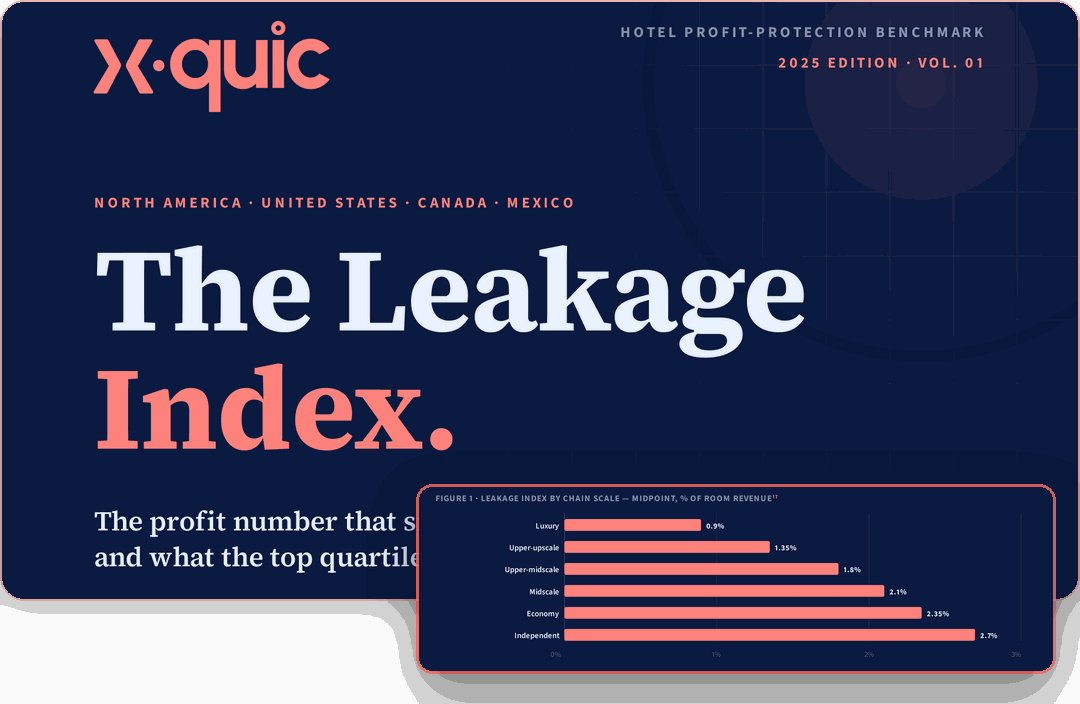
x·quic sits across the seams rather than replacing any system. With read-only access to a hotel's data, it audits every reservation 72 hours after check-out, matches OTA invoices to contracted terms, and reconciles virtual cards, no-show fees, chargebacks and agent commissions. Hotels typically lose 3–12% of revenue to leakage; a free 1-Year Profit Audit shows where yours is. See customer stories for published results.
Frequently asked questions
What is the difference between a PMS and a channel manager?
The PMS manages reservations, rooms and folios inside the hotel. The channel manager distributes rates and availability to outside channels and brings reservations back. Some PMS products include a built-in channel manager.
Is a BI dashboard enough to catch revenue leakage?
Usually not. Dashboards summarize data from your systems, so if a commission is overbilled or a card is never charged, the dashboard often reflects the error rather than flagging it. Transaction-level reconciliation is what finds it.
Who should own the hotel's technology contracts?
That depends on your management agreement. Many owners prefer that key contracts and data rights sit with ownership so they survive an operator change. Confirm with your attorney.
Where can I learn the terms used in hotel technology?
Our glossary defines common hotel finance and distribution terms.
See your own leakage number.
Your free 1-year Profit Audit runs all six 360° audits on your own data and shows exactly what was lost and what is recoverable. No cost, no commitment, nothing to install.
Related guides

One email a month on where hotel profit leaks.
New guides, recovery data and what we are seeing across OTAs, crew lodging and payments. No spam; unsubscribe anytime.