Is Crew Lodging Profitable for Hotels? How to Measure the True Rate


The rate on the contract is not the rate you earn. Here is how to measure crew lodging profit after leakage, displacement and operating costs.
Quick answer: Crew lodging is often profitable for hotels because it fills low-demand nights with steady volume and almost no acquisition cost. But the true profit is the contracted rate minus displacement, extra operating costs and billing leakage. A crew contract that looks good at the rate level can underperform if 3–5% of nights go unbilled or short-paid. Measure collected revenue per crew room night, not contracted rate.
Owners of select-service and extended-stay hotels near rail yards, airports and job sites ask this question every contract cycle. Should we take more crew business, less, or renegotiate? The honest answer depends on four numbers most hotels never put side by side. This post shows how to calculate them.
Why do hotels take crew lodging business?
Hotels take crew business for base occupancy. It arrives on nights transient demand does not, it needs little sales effort once signed, and it rarely comes with OTA commissions.
- Predictable volume: rail, airline and workforce crews need rooms year-round, including off-season weekdays.
- Low acquisition cost: no OTA commission, little marketing, and billing goes to one payer.
- Operating stability: steady occupancy makes housekeeping and staffing easier to plan.
- Occupancy for lenders and brands: a solid base helps metrics that matter at refinancing and brand reviews.
Programs like CLC® exist because workforces need this reliability. The question is not whether crew business has value. It is whether your contract, at your collection rate, earns more than the alternatives.
How do you calculate the true profitability of crew lodging?
Start with the contracted rate, then subtract what the business actually costs you: displaced higher-rated demand, extra operating costs, and revenue you earned but never collected. What is left is your true net rate per crew room night.
- Contracted ADR. The average rate across all crew nights, weighted by tier and room type.
- Collection rate. Crew revenue actually collected divided by crew revenue that should have been collected under the contract. This is the number most hotels skip.
- Displacement cost. On nights you would have sold out, each crew room may have pushed out a higher-rated guest. Count only those nights.
- Incremental operating cost. Extra housekeeping for daytime sleepers, 24-hour front desk load, shuttle runs, early breakfast, wear on rooms, and the labor spent billing and chasing crew receivables.
- Carrying cost. Crew revenue is paid in arrears. Longer AR aging ties up cash.
True net rate per crew night = (contracted ADR × collection rate) − displacement per night − incremental cost per night.
What does crew profitability look like in practice?
The collection rate often matters more than the rate you negotiated. A few points of leakage can erase the difference between a good contract and a mediocre one.
For example (illustrative numbers only): a 110-room hotel runs 22 crew rooms a night at a $92 contracted ADR, about 8,030 nights and $738,760 a year in contracted crew revenue. Suppose:
- Collection rate is 95% (unbilled nights, rate-tier errors, short-pays and missed no-shows cost 5%). Collected: about $701,800, or $87.40 per night.
- Displacement: on 30 sell-out nights, 22 crew rooms displaced guests who would have paid $150. Lost margin: 660 nights × $58 = $38,280, or about $4.77 spread across all crew nights.
- Incremental costs (extra labor, shuttle, billing admin) of about $6 per crew night.
True net rate: about $87.40 − $4.77 − $6.00 = $76.63, far below the $92 on the contract. Raise the collection rate from 95% to 99% and the true net rate rises by about $3.68 a night, or roughly $29,500 a year, without negotiating a single dollar.
Is crew lodging profitable? When it is and when it isn't
Crew lodging is usually profitable when it fills nights that would otherwise sit empty and when the hotel collects close to 100% of what the contract pays. It becomes marginal when it displaces strong transient demand or when billing leaks.
Usually profitable:
- Hotels in markets with soft weekday or off-season demand.
- Properties that rarely sell out.
- Hotels with a disciplined monthly crew reconciliation.
Worth a closer look:
- Hotels that sell out often and hold large crew blocks on those nights.
- Properties where crew AR is aging past 60 days.
- Hotels that cannot say, from a report, what percent of crew nights were billed and paid in full.
What should hotels negotiate in a crew lodging contract?
Negotiate for clarity as much as rate. Ambiguous terms become short-pays later. Before signing or renewing, make sure you understand and can operationalize each of these.
- Rate structure: rates by room type, season and volume tier, and exactly when each applies.
- Guaranteed rooms and no-shows: which rooms are guaranteed, what is billable when a crew does not arrive, and what documentation you need.
- Early departure and extension rules: how partial stays and extensions are billed.
- Late check-out and day-use: cutoffs and what is billable after them.
- Tax treatment: which stays are exempt and what documentation supports it.
- Allowable charges: exactly what incidentals, if any, the program covers.
- Blackout or capacity dates: whether you can limit crew rooms on peak nights to reduce displacement.
- Billing and dispute time limits: what they are and how disputes are submitted.
For how these terms turn into billing errors, see the crew lodging billing errors checklist.
Which crew lodging KPIs should you track monthly?
Track a small set of numbers every month so you can answer the profitability question with data at renewal time.
- Crew room nights and share of total occupied rooms.
- Contracted ADR vs. collected revenue per crew night.
- Collection rate (collected divided by contractually owed).
- Unbilled nights found in reconciliation.
- Short-pay amount and top reason codes.
- Crew AR aging (0–30, 31–60, 61–90, 90+).
- Crew rooms on sell-out nights (displacement).
The collection rate comes straight out of a line-level reconciliation. Our CLC invoice reconciliation guide shows how to produce it.
Where does crew profitability fit in total hotel leakage?
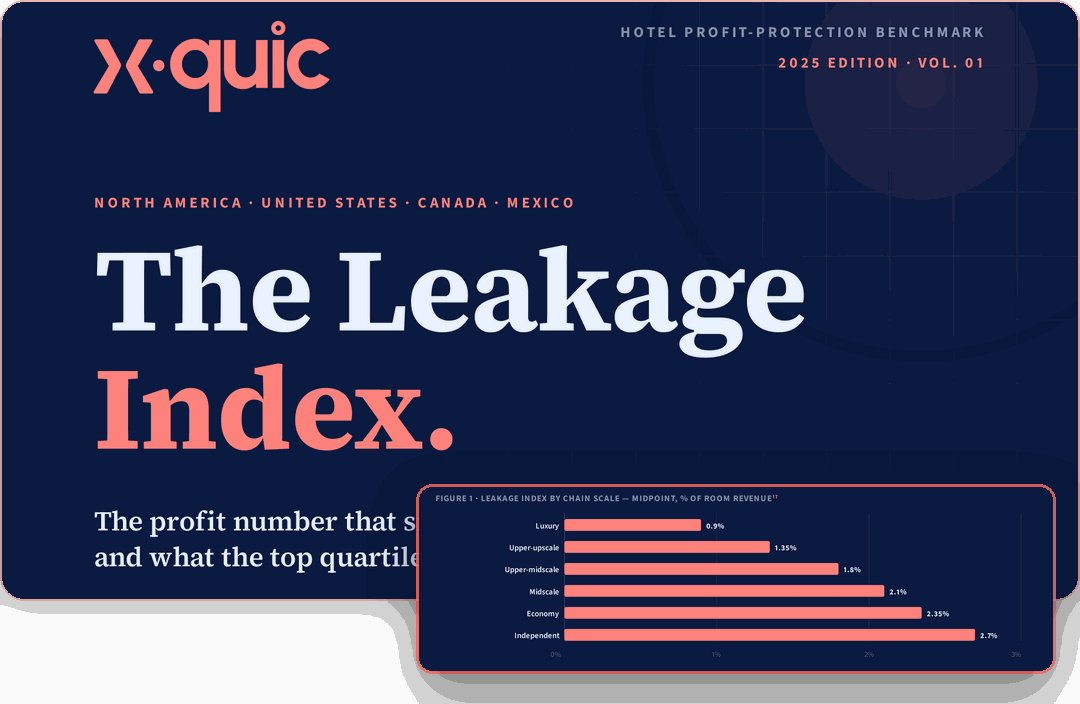
Crew billing is one of several places hotels leak revenue. Hotels typically lose 3–12% of revenue to leakage, depending on the property; on a $4M hotel that is $120,000 to $480,000. OTA commissions, virtual cards, no-show fees, chargebacks and travel agent commissions are the others. See where hotels lose revenue for all six, and the CLC lodging billing audit guide for the crew-specific deep dive.
How x·quic helps
CLC® Secure 360° audits CLC® and other crew and government lodging line by line against how your contract pays, which is how you raise your collection rate without touching your rate. The free 1-Year Profit Audit shows what your crew business actually collected versus what it earned, using your own data, at no cost and with no commitment. See pricing for how it works after that.
See what your crew folios are leaking.
Your free 1-year Profit Audit checks every crew and CLC® room night against what the contract actually pays, on your own data. No cost, no commitment, nothing to install.
Related guides


One email a month on where hotel profit leaks.
New guides, recovery data and what we are seeing across OTAs, crew lodging and payments. No spam; unsubscribe anytime.